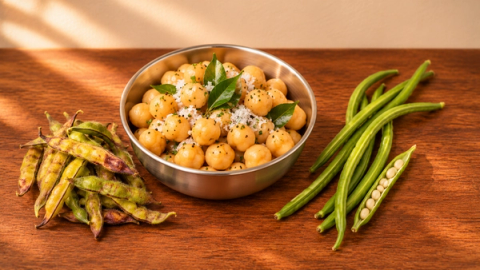
Quick take
The last note ended with a promise: how I keep the legume, the green, the powders and the curd on the plate in a week that is nothing like my mother’s. This is that note. It is mostly about a freezer, a shelf and two pots.
My mother’s plate worked because the parts were always in the house. Dal on the stove, a chutney ground that morning, powders on the shelf, curd set the night before. Nobody planned it. It was just how the kitchen ran, with other hands in it and a market down the road.
My kitchen has none of that. What it has is a freezer, a shelf of jars, two pots that cook under pressure, and a plan for the week that I write and then keep changing.
The last note, Where Does Your Protein Come From?, ended with a promise: how I keep those parts on the plate in a week that is nothing like hers. This is that note. It is not about cooking the way she did. It is about what I do instead, so that the same parts end up on the plate. Some of what’s in my kitchen she would not recognize. My pantry is not hers. It is one I have put together since, learning what works and letting go of what doesn’t, and it is still growing.
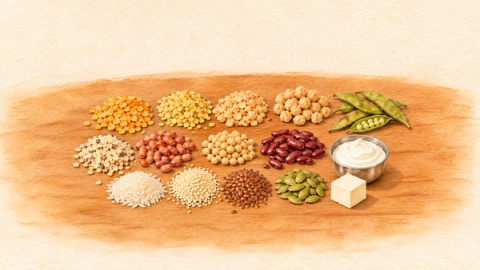
The dal, or the legume
The everyday dal in my house is moong or toor. Both cook fast, both go with anything, and the children eat both without a fuss.
But it can’t be moong every day. Some days it is the dal, some days it is a bean, and the beans are where the planning goes, because they all need a night in water first. Moth beans (matki), kidney beans (rajma), chickpeas (chole): one night soaking, cooked the next afternoon.
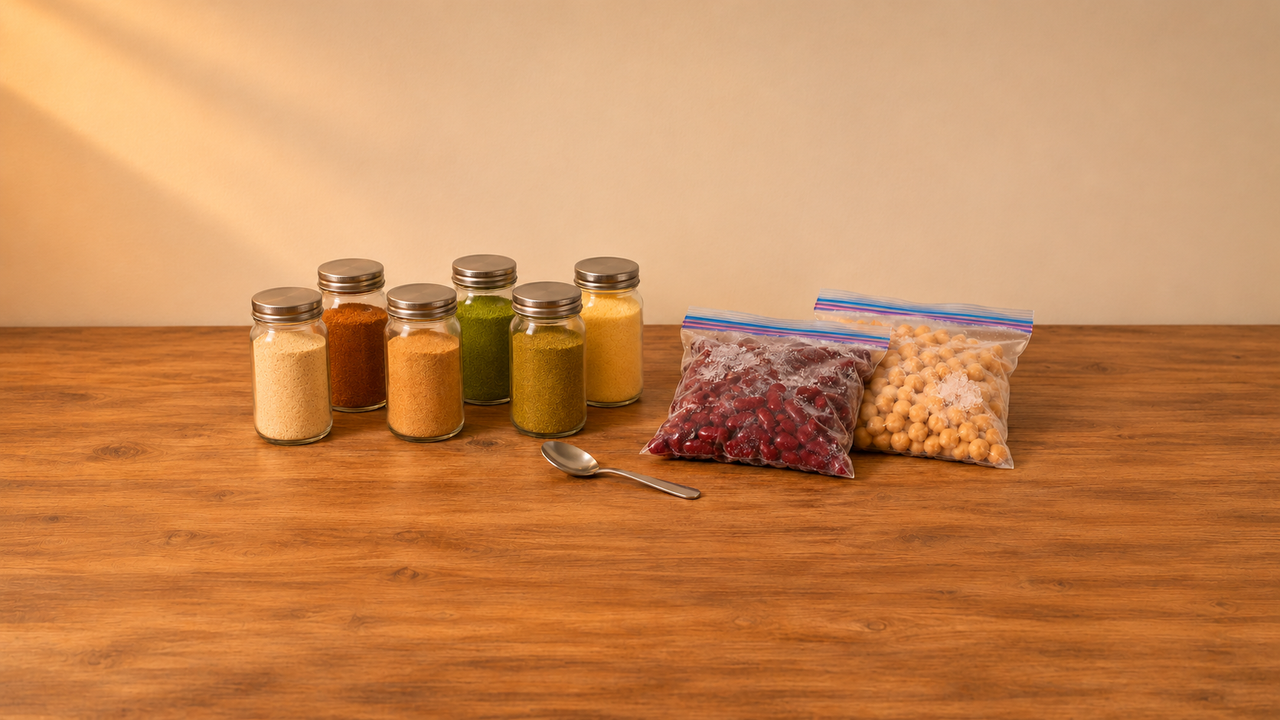
For a long time that soak was the thing that broke the week. If I forgot to put the beans in water on Monday night, Tuesday’s legume was gone. So I started doing the soak in batches. I soak more than I need, drain it, and freeze the soaked beans in bags. Rajma, chole, matki, the black gram and kidney beans for dal makhani, all soaked and frozen, waiting.
Because the week is planned, I usually know which days will be tight. What the plan can’t know is the day that goes wrong anyway: the rough afternoon, the thing that comes up, the evening when the plan is there and the energy isn’t. That is what the bags are for. One goes from the freezer into the Instant Pot with tomatoes, onion, ginger-garlic paste and the spices, jeera rice goes into the second pot or the pressure cooker, and half an hour later there is rajma and rice on the table. The rajma always goes through the pressure cooker, never anything gentler; that is one rule I don’t bend.
None of these beans are from my mother’s kitchen. We never ate rajma or chole or matki growing up, and I learned to cook them after I moved to the US. The only thing I kept from her is the habit: a dal or a legume on the plate most days. She never said it was a rule. It was just how she cooked.
The shelf
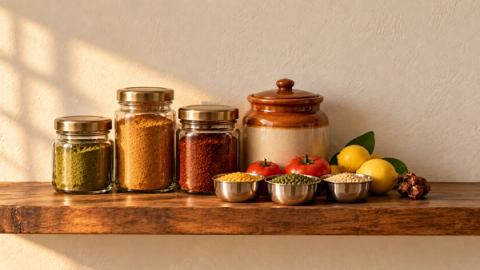
The chutney powders were the first thing that disappeared from my kitchen and the last thing I brought back. Now there are six jars on the shelf.
A seed powder: pumpkin, sunflower and watermelon seeds, ground with coriander, red chilli, cumin and salt. Flax and sesame. A lentil powder. Curry leaf. Moringa. Yellow moong dal.
A spoon of one of these on the rice, or beside the roti, is a small thing, and it is often what makes the plate complete. It needs no cooking at dinner. Either the jar is there or it isn’t.
So the work is all upstream. I make each one at home, a batch about once a month, and only a little goes into the small bottle on the shelf; the rest sits in a bigger jar in the fridge. They don’t all get made on one weekend, and they don’t run out together either. One finishes before the others, depending on which one the children have taken to that month, however much I try to rotate them, and that one gets made again.
The green
Spinach is the weekday green. It goes into the dal, into the thepla dough, into whatever is being cooked, because it needs no planning and the children have stopped noticing it.
Around it there are jars that don’t need a market trip: dried spinach, dried fenugreek leaves (kasuri methi), dried moringa leaves, and moringa leaf powder for the roti dough. Fresh fenugreek most weeks, and mint from the garden. And there is always a sorrel leaf (gongura) paste, cooked and stored ahead, to fall back on when the fridge has nothing fresh.
Then whatever is in season and in the market: amaranth leaves, Malabar spinach, beet leaves, daikon radish leaves.
For a while I grew microgreens on the windowsill too, and leaned on them in winter when fresh greens are thin. I have let that slip lately; life got busy. I’ll get back to it.
The nights nothing gets cooked
There are nights when nothing gets cooked, and I don’t fight them any more.
On those nights it is frozen dumplings (momos) from the shop, and beside them a bowl of kanji, which I started making this winter: a porridge of sorghum (jowar) one day, black gram another, horse gram, finger millet (ragi). The dumplings are the dinner. The kanji is what makes it a proper dinner and not just a snack, and it takes almost nothing to make.
Or it is a grilled cheese made at home and a soup from the shop, and that is the whole meal, and that is fine.
A night like that does change the day; it is not the dinner I planned. I just don’t feel bad about it or get upset with myself. What I do watch for is a week where I never got around to soaking the beans.
When a child says no to the dal
It happens. One of mine will look at the dal and decide that tonight is not the night.
I don’t negotiate. I make sure there is curd on the plate, because curd is the one thing nobody refuses, and I let the legume arrive some other way. A black-eyed pea crepe. A mixed-lentil crepe (adai). A chickpea-flour pancake (chilla). A moong dal crepe (pesarattu). The batter is in the fridge more often than not, because this happens more often than not.
A sorghum (jowar) thepla with some green kneaded into it is one of the regular dinners, a roti with a little of everything in it. And there is a side that came home from a trip: the children tried sautéed edamame once, loved it, and it has been on the list ever since. On a night when the dinner leans a little thin, that is what goes beside it.
What holds
I don’t think the plate I have described is perfect, and I know the week won’t be. What I can tell you is what holds it together when it isn’t.
Soaked beans in the freezer, so a bean dinner doesn’t depend on whether I remembered to soak them the night before. Six jars on the shelf, each made when it runs out. A green in a jar for the week the market was missed. A batter in the fridge for the night the dal is refused. A pot of kanji for the night nothing is cooked. And curd, every day.
None of this was built at once. These habits took me two to three years of trying things on purpose, seeing what stuck and dropping what didn’t, and I am still learning.
The plate is whole when the parts are already in the house.
Then I look back at the week, not at any one day, the way I wrote about in The Tally I Keep at Seven O’Clock. Did the children get enough to eat, was there protein across the days, was there a green most days. I keep changing the week’s plan, and sometimes I catch myself sitting over it trying to make it perfect. It never is, and that is when I stop. As long as the parts are in the house, the plate takes care of itself.
PS: This is a reflection, not medical or nutrition advice. If something about how you or your children are eating is worrying you, please talk to someone who can look at it properly. Every body is different, and so is every kitchen.