Quick take
For years I kept a tally at dinner without knowing it. This note is about where it came from, why my mother never kept one, and what changed when I learned that the body does not count by the day.
Most evenings, around seven, I start counting. Some nights dinner is rotis or parathas, other nights it is dal and rice. The counting is the same.
I don't write anything down. It happens in my head while I'm still cooking. Is there protein in this? Is there anything green on the table? And then I do it again after dinner, when I see what the children finished and what came back.
The second count is the one that decides how I feel. Some evenings it's fine, but most evenings it's not quite.
I have been doing this for years. Until recently I never asked where the habit came from, or whether a single day can even be measured like that.
What I was actually doing
I was grading dinner, and I didn't know I was doing it. Somewhere along the way I had picked up the idea that a day of food can pass or fail, and that a good mother's job is to make it pass. So every evening was a small exam, and I gave myself a mark each time.
And it was never full marks, because there is always something. The dal was thin. Nobody touched the vegetable. It was curd rice again, because the day had been long.
If you do this too, there is nothing wrong with you. I think many of us do it, and nobody asked us to.
Where the tally came from
I learned nutrition the way most of us did, from a chart.
Vitamins on one side and numbers next to them: iron, calcium, protein, B12. Each number was an amount per day.
So I read it as a list of things to finish every single day.
Nobody told me that those numbers are averages over time, and that some days can be higher and some lower. It is all written down, in the pages around the chart that most of us never read. I went and read them this year, and it changed how I look at dinner.
Amma never kept a tally
She cooked for all of us, every day, without a single number in her head.
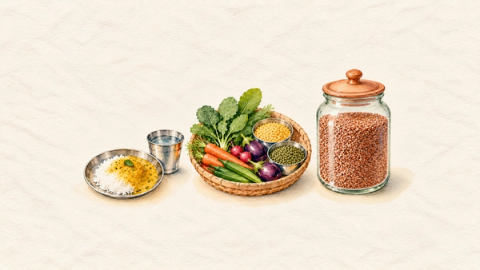
The dal changed through the week: toor, moong, chana dal. It changed with the greens. Whichever leaf was going into the pot decided which dal went with it. The greens changed with the market and the season, so the dal changed too.
Nobody in that kitchen called it rotation. It was just how you cook greens.
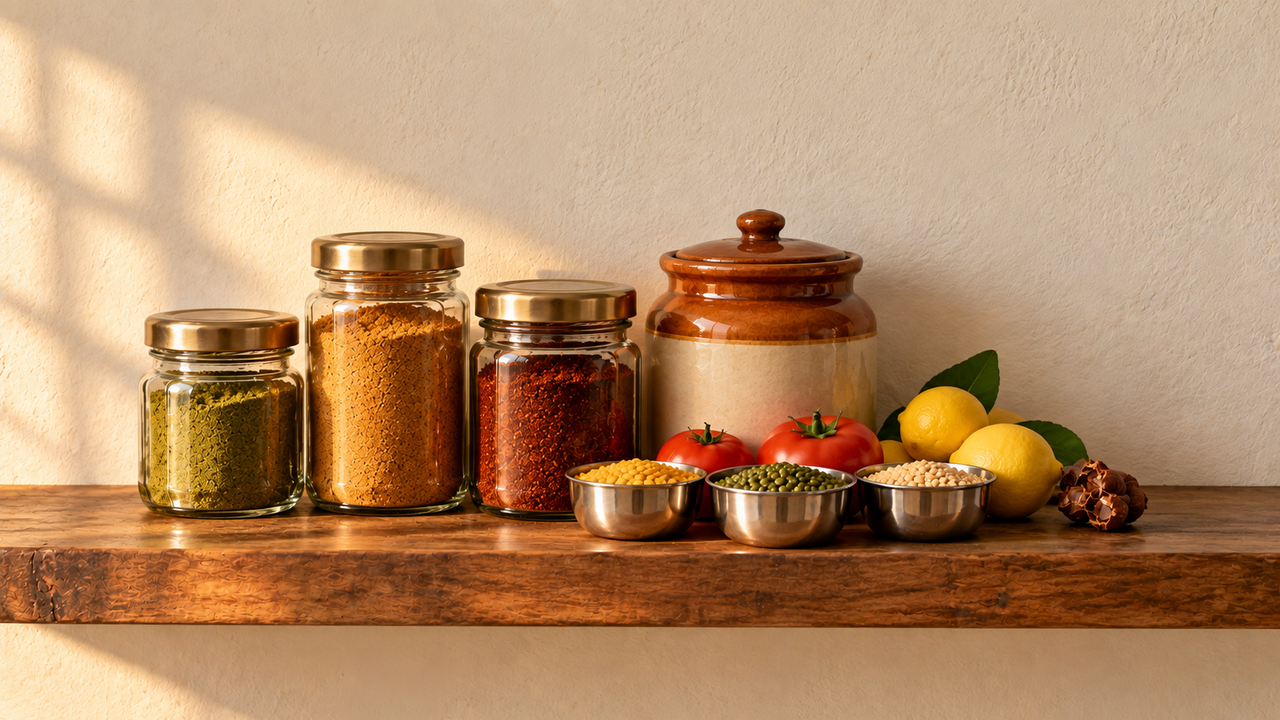
There was always something sour, and rarely the same one two days running: lemon, tamarind, tomato, amla when it was in season. They were all in the house, and she reached for whichever one suited what she was making.
The chutney powders were the same: moringa, flaxseed, curry leaf. Several jars stood on the shelf at once, and she didn't wait to finish one before grinding the next.
Curd was in everything, so nobody had to remember it.
I had this part backwards for years. In her kitchen the variety was on the shelf.
What I keep coming back to is that she had no way of knowing whether any single meal was complete, and I don't think she ever asked. She was cooking for a week, a season and a household.
I don't think she could have explained any of it as a system. It is simply what a kitchen does when it follows the market, the weather and what people feel like eating.
Was it just tradition? Or was it a kind of quiet intelligence?
What actually changed for me
I learned that the body runs on different clocks. Some things really do have to come today. Others the body has been holding for months or years. Knowing this made me a less anxious cook.
I have written all of it out in the Learning Grove: The Rent, the Rhythm, and the Reserve. It explains which nutrients are due today, which ones balance out over a few weeks, and which ones the body stores for years. If this note is the heart, that one is the clarity.
At seven o'clock I had been asking was tonight enough? Now I ask what has this week been made of? That one I can sit with on a Sunday, without dread.
It also made sense of something Amma said to me years ago. She said my cooking was healthy, but it was always the same four or five vegetables.
I took that as a comment on my meals, but she was talking about my week. She had cooked that way all her life without ever calling it anything. I had kept her dishes and lost her rotation.
What I kept
Dinner still matters, as one of seven.
The noticing stays too. It comes from caring, and I'd rather be the mother who notices than the one who doesn't. I just don't judge the day by it anymore.
And some things do need a doctor. If something doesn't feel right with me or the children, I would rather ask than guess.
Seven o'clock, now
The habit hasn't gone. I still count while I cook, and I still notice what comes back. I probably always will.
But what I say to myself at the end has changed. It used to be not quite. Now it is more often this is one of seven, and the week has been decent.
The bottle gourd (lauki) or the ivy gourd (tindora) will go untouched two evenings in a row. I notice it, and I let it go. Then some other week it gets eaten without anyone saying a word. I didn't manage any of that.
I'm not sure Amma would understand the relief I feel about all this. She would wonder why I was counting in the first place.
If you are standing at your own stove tonight, keeping your own tally, you are doing it because you care. It just doesn't have to be settled tonight.
PS: This is a reflection, not medical or nutrition advice. If something about how you or your children are eating is worrying you, please talk to someone who can look at it properly. Every body is different, and so is every kitchen.