Quick take
How much protein a child needs, where it sits on an Indian vegetarian plate, why the plate has to be put together on purpose, and my view on protein powder.
The question
Where does your protein come from? Anyone who feeds a vegetarian family gets asked this, and for most of my life I had a one-word answer. Dal. I said it with confidence, because it was the only answer I had.
It is still my first word. It is no longer the whole answer, and the rest of it took me years and two children to learn. The story of how I got there is in a Nourish Note alongside this article. This is the part I wish someone had put in front of me at the start: how much protein a child needs, where it already sits on our plate, and why a vegetarian plate has to be put together with a little more care than one with meat or eggs on it.
Iron, vitamin B12 and vitamin D each get their own article. This one is about protein only.
How much is enough
The number is smaller than most of us expect.
The recommended amounts for Indians come from ICMR-NIN. For a child of seven to nine, the recommended daily allowance is 23.3 g of protein a day, and the average requirement, which is what NIN says to plan a day’s food around, is 19 g.[^1] For a child of four to six it is 15.9 g and 12.8 g. For a ten to twelve year old, 31.8 g for a boy and 32.8 g for a girl, with average requirements of 26.2 and 26.6. An adult woman’s allowance is 45.7 g and a man’s 54.1
Put another way, a child needs a little under 1 g of protein for every kilogram they weigh, and an adult about 0.8 g.1 The number grows with the child, and so does the appetite that goes with it.
Protein is one of the things the body asks for every day. There is no store of it the way there is for iron or B12. What the body does keep is a working supply of amino acids, the building blocks of protein, which it draws on and tops up through the day.2 So the day is the window to look at, as the Rent article explains, and one thin bowl of dal at dinner does not decide it. The Rent, the Rhythm, and the Reserve has the longer version.
Now put the energy number next to it.1
| Weight | Protein a day | Protein per kg | Energy a day | Energy per kg | |
|---|---|---|---|---|---|
| Child, 7 to 9 | 25 kg (56 lb) | 23.3 g | 0.92 g | 1,700 kcal | 67 kcal |
| Woman, desk work | 55 kg (121 lb) | 45.7 g | 0.83 g | 1,660 kcal | 30 kcal |
| Man, desk work | 65 kg (143 lb) | 54 g | 0.83 g | 2,110 kcal | 32 kcal |
Read across the child’s row and then down. A child of seven to nine needs half the protein of a grown woman and the same amount of food. For their size, that is about the same protein per kilo as an adult and twice the energy. That is what growing costs, and it is why the rice, the roti and the ghee on a child’s plate are doing a job of their own.
Turn the grams into calories and the child’s requirement works out to about 5% of the day’s energy, against about 11% for a grown woman. That is the floor, and an ordinary plate gives two to three times it. The rest of the day is fuel, and on our plates that is mostly rice, roti and ghee.
The US reference values say the same thing in their own numbers. There, a child of four to thirteen is given 0.95 g of protein per kilogram and an adult 0.80, so 19 g a day at four to eight and 46 g for a woman, while a moderately active eight-year-old’s energy need is put at 1,600 kcal, against 1,800 to 2,000 for a woman in her twenties with a desk job.67 The US ranges go further for the youngest children: from one to three, protein may be as little as 5% of a day’s energy, and fat as much as 40%, the lowest protein floor and the highest fat ceiling of any age.6 Whichever table you read from, a growing body runs on fuel first.
On an ordinary vegetarian day the protein takes care of itself if the food is there. NIN’s own suggested day of food for a child of this age, with 200 g of cereals, 65 g of pulses, a green, two vegetables, fruit, a few nuts and seeds and 400 ml of milk or curd, comes to about 1,700 kcal and 59 g of protein before any allowance for quality.3 The protein is more than twice the number.
It is easier to see on a day that looks like ours. Here is one, with the protein worked out from the Indian food tables for the amounts a child of seven to nine might eat.5 The amounts are raw weights, before cooking.
| On the plate | Protein | |
|---|---|---|
| Breakfast | Two moong dal crepes (pesarattu), from 30 g of green gram, with a peanut chutney (10 g peanuts) | 9 g |
| Mid-morning | A glass of milk, 200 ml | 7 g |
| Lunch | Rice (60 g) with dal (25 g), a vegetable, and curd on the side (100 g) | 14 g |
| After school | Peanut brittle (chikki) made with 20 g of peanuts | 5 g |
| Dinner | Two rotis (60 g atta) with a dal (25 g) and a vegetable | 12 g |
| The day | about 44 g |
The vegetables and the fruit are not counted, and they add a little more. Take the milk and the curd out of that day and it is still about 35 g. Count only three quarters of it as quality protein, the way the Indian guidelines do for a plant-based day, and it is still about 33. The allowance is about 23. Swap the lunch for a potato paratha and the dinner for rice with a vegetable curry, and the day drops by a third, which is why the legume at breakfast or at dinner matters more than any one meal does. The question on a child’s plate is usually whether there is enough food on it, not whether there is enough protein.
What the number counts
Here is the part that is specific to a vegetarian plate. When NIN talks about protein it is careful to say "quality protein", and quality means two separate things. How much of the protein in a food the body actually takes in, and whether the nine amino acids the body cannot make are all there in the right proportion. A food can fall short on either, and the scores nutritionists use for protein quality are built from those two things.1 This article stays with the plain version.
How much gets taken in
The protein in a dal is not all taken in. Plant foods arrive as a package. The protein comes wrapped in fiber, starch and the walls of the plant cells, and the body gets through some of that package and not the rest. The Indian guidelines put the digestibility of most vegetarian foods at 70% to 85%.3 So 30 g of raw dal, with about 6.5 g of protein in it, gives the body about 5 g. The guidelines allow for this in a simple way. On their own example of a plant-based day, a little over 80 g of crude protein counts as about 60 g of quality protein, roughly three quarters.3 And for a diet built mostly on cereals, with little else, NIN raises the requirement to 1 g for every kilogram of body weight.1
That share is not fixed. It depends on what the kitchen does to the dal before it reaches the plate. Soaking, sprouting, fermenting and cooking in water all open the package a little further, so more of the protein gets through;1011 in chickpea, measured in the lab, cooking raised the digestible share from about 72% to about 84%.9 The soaked dal, the fermented batter, the sprouted moong and the pressure cooker were all doing this long before anyone measured it. Which technique does what, and what each one costs, is an article of its own that is coming.
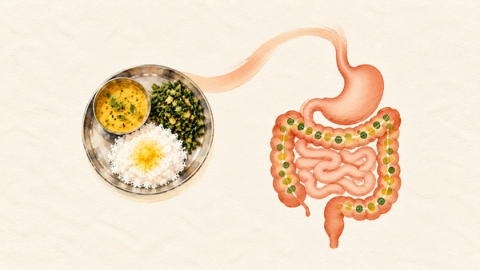
The same package is what makes a vegetarian plate good for the gut. The part of the dal we cannot digest travels on to the large intestine, where the microbes living there ferment it and are fed by it.4 Paneer gives up its protein more completely than dal does, and paneer feeds the gut hardly at all. A lower share taken in and a well-fed gut come from the same fact about plant food. What Is the Gut? follows one plate down that path.
Whether the parts are all there
Protein is made of about twenty amino acids, and the body needs nine of them from food. Cereals are short of lysine. Pulses are short of methionine. Each has what the other lacks, and the guidelines say it plainly: a meal with both pulses and grains in it supplies all the amino acids.3 NIN puts it as a ratio, cereals and pulses in about three parts to one by raw weight, with 250 ml of milk in the day.31 When the guidelines ran the numbers on their own suggested vegetarian day, every essential amino acid came out above the requirement on paper, lysine by the narrowest margin.3 Once digestibility is counted the plate is close rather than comfortably over, and that is what the milk in the ratio is for.
This is why "dal alone" was never the answer and never needed to be. The rice under the dal is doing a protein job, not only filling the plate, because it brings the amino acid the dal is short of. The dal returns the favor. And the curd at the end adds protein the body takes in almost completely, which is what the 250 ml of milk is doing in NIN’s ratio. A plate of rice and dal with a bowl of curd has been covering all nine without anyone counting.
The guidelines also say something that is worth reading twice. By their account, an ordinary adult’s day in India already gives 60 to 70 g of protein, more than the body needs, and the real question is the quality of that protein and whether all the essential amino acids are there.3 On a plate built the traditional way, the amount is rarely the problem. Whether the parts are all there is.
That sentence was written about India, and many of us are not cooking there. A week in the diaspora is often a mixed one: cereal or toast at breakfast, a sandwich or pasta at lunch, dal on some nights and not others, and no chutney powder on the shelf. On a week like that the amount is no longer a given, because the dishes that carried the protein, the dal, the rice under it, the powders, the curd, are the ones that drop out first, and nothing in the new meals takes their place. The guideline’s sentence still holds, in a different sense. The way back is the same parts, not more protein in one meal.
What comes with it
One more thing the number does not show. On a vegetarian plate, protein never comes alone, and what it comes with is different for each food.5 Red gram dal is about 22% protein by raw weight and 55% carbohydrate. Rice is 8% protein and 78% carbohydrate. Sesame is 20% protein and 43% fat. Paneer is 19% protein and 25% fat, with almost no carbohydrate. Soy is 36% protein with 20% fat and 12% carbohydrate. Milk and curd are 3% protein, with about as much fat and carbohydrate again.
Put it as calories per gram of protein and the spread is wide: about 10 kcal for every gram of protein in soy, 15 in dal, 16 in paneer, 22 in milk, 26 in sesame, and 45 in rice.5 Two things follow. The first is that cutting the rice to cut carbohydrate cuts protein too, and swapping rice for more dal changes the ratio without escaping the carbohydrate, because the dal is more than half carbohydrate itself. The second is that getting a day’s protein from dal and rice alone means eating a fair amount of food, which is why a plate like that fills you up before you are done. Anyone eating to a calorie target should know both of these, because on a vegetarian plate the protein with the least energy attached is in the curd, the paneer and the soy, used alongside the dal rather than instead of it. What the target should be, and how to get there, is a question for a doctor or a dietitian and not for this page.
Where it is on our plate
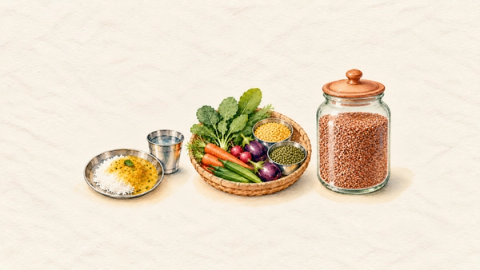
The plate I grew up with had two curries. One was a dal, or a ground chutney of peanuts, sesame or lentils with greens or vegetables. The other was a dry vegetable. Beside them sat plain thick dal and rasam, and the meal ended with curd. Nobody at that table called any of it protein, and it was in four places.
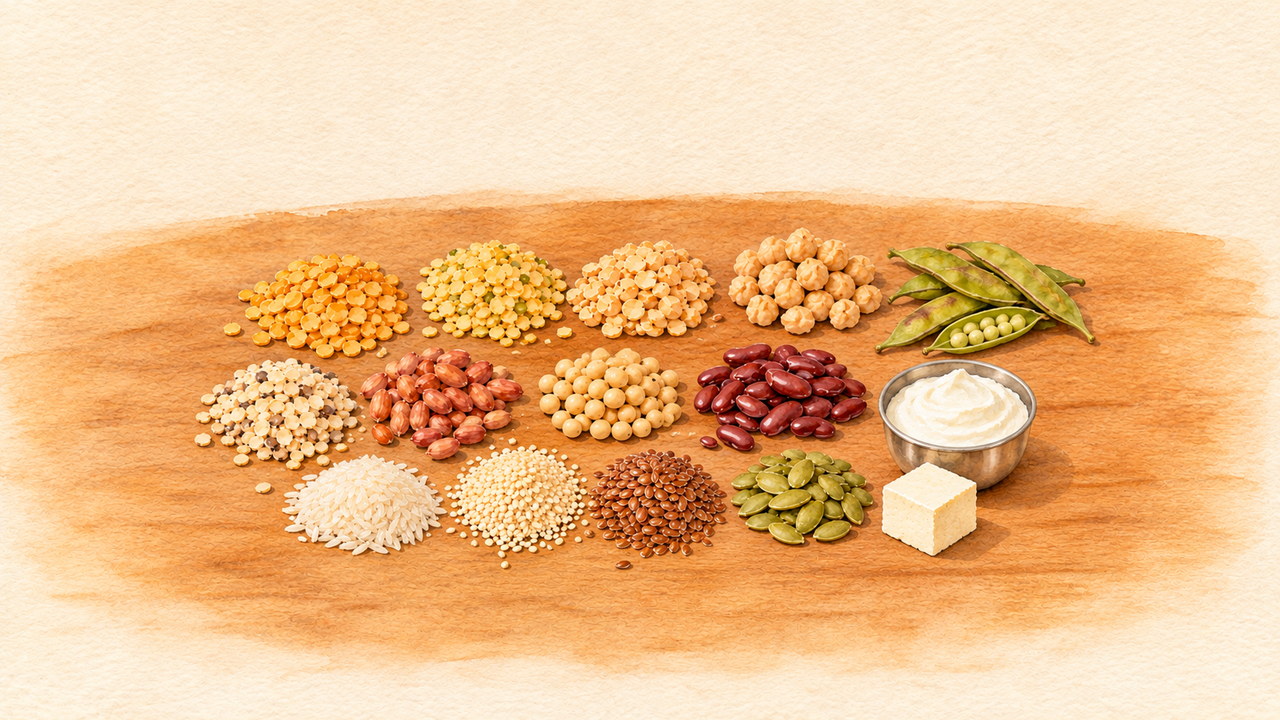
The dals are the obvious one. Red gram, green gram, Bengal gram, black gram and lentils are all about a fifth protein by raw weight, give or take.5 They are close enough to each other that rotating them changes the mix of amino acids and the food the gut gets more than it changes the grams.
The chutney powders and the chutneys are the ones nobody counts. Peanuts and sesame seeds carry about as much protein as the dals, and most of the powders on an Indian shelf grind a seed or a leaf together with lentils.5 A spoon on the rice adds to the day without anyone noticing.
The cereal is the one we forget. Rice is about 8% protein by raw weight, whole wheat flour about 10%, finger millet (ragi) about 7%.5 On a plate where the rice outweighs the dal three to one, the rice carries about as much protein as the dal. That is the ratio NIN names, and it is why the cereal on the plate counts.
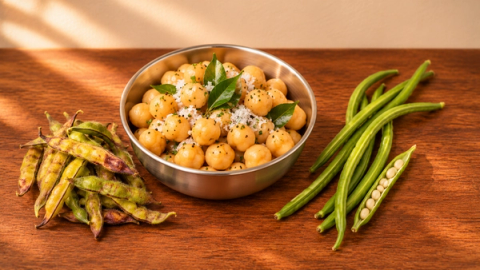
Then curd and milk, paneer when it is there, and the snacks that are legumes without being called that: boiled chickpeas tempered with mustard and curry leaves, fresh pigeon peas and fresh cowpeas in season, a handful of roasted peanuts. Soy belongs on this list too, as soy chunks in a curry or tofu cooked the way we cook paneer. By raw weight it has nearly twice the protein of a dal.5
Nourishfully Insight: On a vegetarian plate the protein is spread out. It is in the dal, and it is also in the rice, the chutney, the curd and the evening snack. Dal is the beginning.
Putting it together on purpose
A plate with meat or eggs on it gets its protein from one dish. A vegetarian plate gets it from the whole plate, so it has to be put together on purpose. The traditional meal did this without a chart, and a busy week does not always.
The habits that do the work are few:
- A legume every day, in some form. As the dal at lunch, or as breakfast: a moong dal crepe (pesarattu), chickpea-flour pancakes (chilla), a mixed-lentil crepe (adai), or a dosa with dal in the batter. A day with no legume on it is the day to watch for.
- Keep the cereal and the dal together. Rice with dal, roti with dal, dosa with lentil and vegetable stew (sambar). The ratio looks after the amino acids.
- Curd or milk in the day. It adds protein the body takes in easily, and it rounds off the mix.
- Rotate the dal. Each dal brings a slightly different mix, and the gut’s microbes do better on variety.
- Seeds and nuts, a little, often. A chutney powder on the rice, peanuts in the snack, sesame in a sweet.
- Breakfast is the easy win. A legume breakfast means the day starts with a third of the number already on the table.
None of this needs a scale. It needs a shelf with several dals and a few powders on it, and a week that uses them.
The protein powder question
Sooner or later someone suggests a scoop of powder for the child. Here is how I think about it.
A powder is protein taken out of milk or soy or peas and dried. It is protein without the package: no fiber, no minerals, little for the gut, none of what comes with the dal. That is not a reason to fear it. It is a reason not to expect it to do the plate’s job.
The Indian guidelines take the view that good protein comes from combining foods, and that for a healthy person eating a balanced diet, a supplement on top of meals does not build more muscle.3 The American Academy of Pediatrics tells parents much the same about young athletes on a well-balanced diet.8 The AAP adds that vegetarians may be at risk of not eating enough protein, and may do well to plan their meals with a dietitian. For a plate with the meat taken off and nothing put in its place, that is fair, and it is the one week this article is trying to keep us from drifting into. A plate built on dal, rice, curd and seeds covers that risk without anyone having to think about it.
So my view, for an ordinary child on a week like the one above, with a legume on it every day, is that food does the whole job. A powder becomes a question worth asking when a child is not eating, has refused the legumes for weeks rather than days, is unwell, or has been told by a doctor to gain, and then it is a question for the doctor or a dietitian, not a default.
A child who plays
One of my children has taken to sport, and the question came up at home before it came from anyone else. Does a child who trains need more?
The NIN table already gives a growing child more protein for their weight than it gives an adult, because growth is built in.1 It gives no separate figure for a child who plays sport. What the guidelines do say is about adults who train, and it points the same way: most athletes can get the protein they need from food,3 and in adults doing resistance training, protein beyond about 1.6 g per kilogram a day adds nothing further to muscle.3 That figure is for grown bodies, and I would not stretch it to a child. The point underneath it carries over, though. What changes most with training is appetite, and a child who is hungrier and eats more of the same plate takes in more protein with it. The plate does not have to change. It has to be there, with the legume on it, on the days the child is tired and would rather not eat.
What to take from this
This article is for education and is not medical advice. If a child is not growing as expected, is often tired, or is eating very little, that is a question for a doctor, and a blood test tells more than any article can.
For the rest of us, the question "where does your protein come from?" has a longer answer than it used to. It comes from the dal, and from the rice under it, the chutney beside it, the curd at the end, and the snack at four o’clock. It comes from a week that has a legume on it every day. Dal is the beginning.
The personal side of this question is in Nourish Notes: Where Does Your Protein Come From?
PS: This guide is for education. It does not replace personal medical or nutrition advice. Every body is different, and so is every kitchen.
References
Each source is labeled by the kind of evidence it is.
Requirements
- 1
ICMR-National Institute of Nutrition. A Brief Note on Nutrient Requirements for Indians, the Recommended Dietary Allowances (RDA) and the Estimated Average Requirements (EAR), ICMR-NIN, 2020. Hyderabad: ICMR-NIN; 2020. Tables 1b and 2a.
Protein and energy requirements by age; the 1 g/kg footnote for cereal-based diets
- 2
World Health Organization, Food and Agriculture Organization, United Nations University. Protein and Amino Acid Requirements in Human Nutrition: Report of a Joint WHO/FAO/UNU Expert Consultation. WHO Technical Report Series 935. Geneva: World Health Organization; 2007. Section 2.7.
The free amino acid pool; no protein store
Indian guidelines
- 3
ICMR-National Institute of Nutrition. Dietary Guidelines for Indians. Hyderabad: ICMR-NIN; 2024. Guideline 8, pages 57 to 61; Table 1.6, page 12.
Protein quality, 3:1 cereals to pulses, digestibility 70 to 85%, Table 8.2, supplements, the suggested day for a child
Requirements
- 4
Food and Agriculture Organization, World Health Organization. Carbohydrates in Human Nutrition: Report of a Joint FAO/WHO Expert Consultation, Rome, 14–18 April 1997. FAO Food and Nutrition Paper 66. Rome: FAO; 1998.
Fibre fermented by the colonic bacteria
Food values
- 5
Longvah T, Ananthan R, Bhaskarachary K, Venkaiah K. Indian Food Composition Tables 2017. Hyderabad: ICMR-National Institute of Nutrition; 2017.
Protein, carbohydrate, fat and energy per 100 g raw; curd taken at the milk value
US reference values and advice
- 6
Institute of Medicine. Dietary Reference Intakes for Energy, Carbohydrate, Fiber, Fat, Fatty Acids, Cholesterol, Protein, and Amino Acids. Washington, DC: The National Academies Press; 2005.
Protein RDA by age and the acceptable macronutrient ranges
- 7
U.S. Department of Agriculture, U.S. Department of Health and Human Services. Dietary Guidelines for Americans, 2020–2025. 9th ed. December 2020. Appendix 2, Table A2-2, page 140.
Calorie needs by age: a moderately active eight-year-old, 1,600 kcal
- 8
American Academy of Pediatrics. Performance-Enhancing Sports Supplements: Information for Parents. HealthyChildren.org. Adapted from Performance-Enhancing Supplements (Care of the Young Athlete), American Academy of Pediatrics; 2016. Updated October 16, 2026.
Young athletes on a balanced diet do not need protein supplements; vegetarians and meal planning
Cooking and digestibility
- 9
Clemente A, Sánchez-Vioque R, Vioque J, Bautista J, Millán F. Effect of cooking on protein quality of chickpea (Cicer arietinum) seeds. Food Chem. 1998;62(1):1-6. doi:10.1016/S0308-8146(97)00180-5
In vitro protein digestibility 71.8% to 83.5% with cooking
- 10
Ghavidel RA, Prakash J. The impact of germination and dehulling on nutrients, antinutrients, in vitro iron and calcium bioavailability and in vitro starch and protein digestibility of some legume seeds. LWT Food Sci Technol. 2007;40(7):1292-1299. doi:10.1016/j.lwt.2006.08.002
Germination raised in vitro protein digestibility in all four legumes
- 11
Yadav S, Khetarpaul N. Indigenous legume fermentation: effect on some antinutrients and in-vitro digestibility of starch and protein. Food Chem. 1994;50(4):403-406. doi:10.1016/0308-8146(94)90213-5
Fermentation raised in vitro protein digestibility of the batter