Quick take
The question nobody asked me in India, the one-word answer I gave for years, and how my answer changed after I started feeding a family.
Nobody asked me where my protein came from when I was growing up in India. The first time I remember the question was years later, and I don’t even remember who asked.
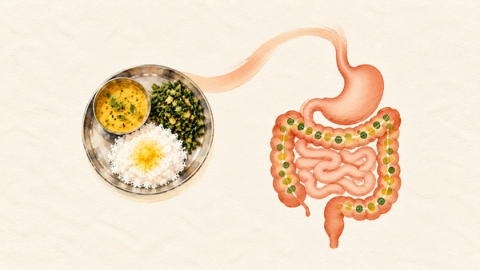
Food, for me, was dal, rice, ghee, vegetables, rasam and yogurt. That was a meal. When people around me started talking about food as carbs, protein and fat, I was lost. I knew how to cook a full meal. I had never once thought of it in those words.
So when the question came, I had a one-word answer. Dal. I said it with confidence, because it was the only answer I had.
The first time I understood the words
It took my first child for me to look at food any other way.
That was the first time I understood what macros and micros were. I find that hard to believe now, but it is true. Before that, I did not look at a plate and see protein. I saw dal.
Once I started reading, I read to make sure I was not missing anything, and to understand what all these conversations about protein were about in the first place. I read a book on plant-based eating written by dietitians, for the basics of protein and to check what I thought I knew against what they teach. Later I read one written for athletes, because one of my children has taken to sport, and I wanted to know that a growing body that trains was getting what it needed from our kitchen.
Both books answered the protein question the same way. Tofu, soy, beans I had never cooked. There is nothing wrong with that answer. Tofu goes into my kitchen every week, alongside paneer, and I’m happy to borrow from anywhere as long as our stomachs agree with it. But tofu is not the hero of my kitchen, and it never will be. My question was a different one. What was the food I grew up on already offering, where were its real gaps, and how do I fill them without leaving that food behind.
My mother’s plate
So I went back to the plate I grew up with.
My mother served two curries. One was a dal, or a ground chutney (roti pachadi) of peanuts, sesame or lentils with greens or vegetables. The other was a dry vegetable. Beside them sat plain thick dal (mudda pappu) and rasam, and the meal ended with curd.
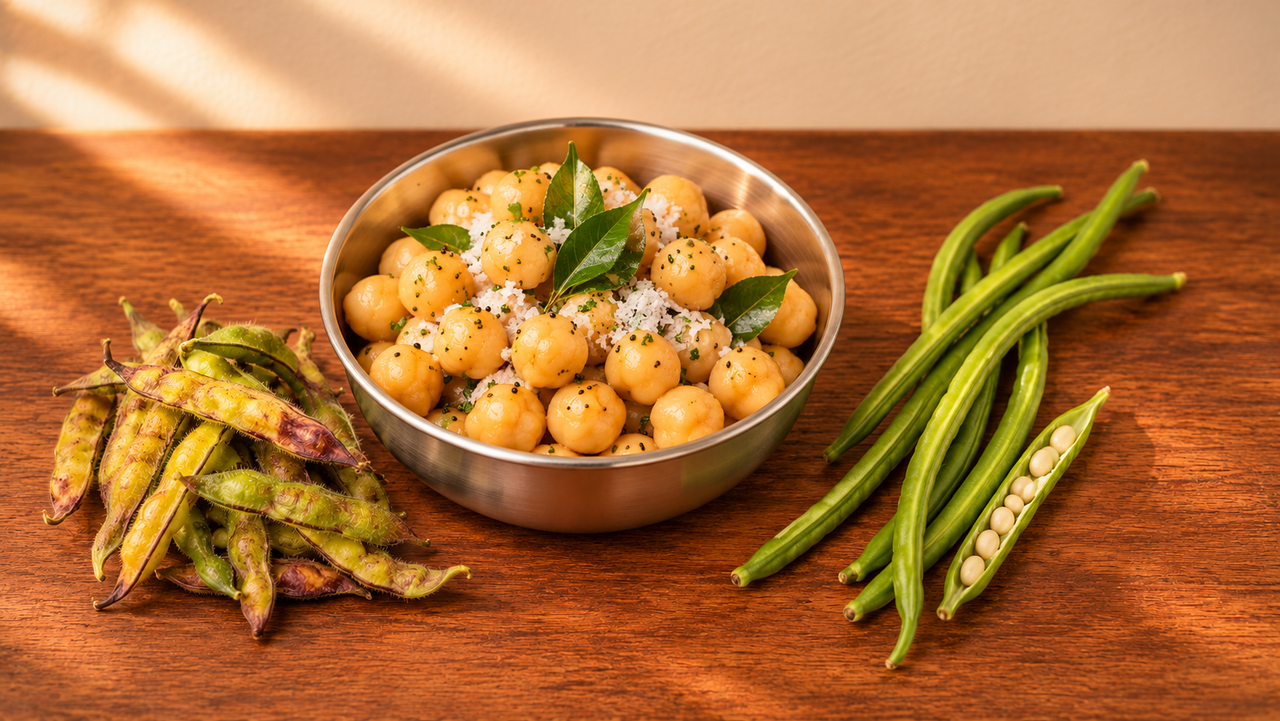
At my grandmother’s house, the snacks were sundal, boiled chickpeas tempered in the pan, and in season, fresh pigeon peas (kandi kaya) and fresh cowpeas (babberlu).
I had eaten from that plate my whole life and never once counted it. When I finally did, the protein was everywhere. In the dal, yes. Also in the peanuts and sesame in the chutney, in the rasam, in the curd at the end, and in the rice under all of it. The snacks were legumes. Nobody called any of it protein. Nobody needed to.
For most of my life my answer was one word. Dal.
It was only recently, learning about the gut and about nutrition, that I could see how well that plate was put together. I had to learn the words before I could see what my mother was doing without them.
The plate has its weak side too. There is a lot of rice on it, or roti, and a small bowl of dal next to it. And the protein in dal, rice and seeds doesn’t all get taken in the way protein from paneer or an egg does.
So nothing on that plate carries the protein by itself. It works because all the small things add up. The dal does a part. The rice does a part. The chutney, the curd, the handful of sundal in the evening, each does a part. Take any one of them off and the plate is a little short somewhere.
Skip the dal and the biggest part is gone. Eat the dal with a salad instead of rice or roti and you lose more than you’d think, because the rice was carrying a share too. Forget the curd, and something small goes missing. Dal and rice together cover the building blocks of protein between them. The curd adds a share that the body takes in more easily. Let the chutney powders run out, and that spoon of seeds and lentils on every plate is gone with them. Let the evening snack turn into biscuits, and an afternoon that used to have a handful of legumes in it now has none.
None of these is a big deal on its own, and that is how it happens. The plate doesn’t stop working in one go. It stops working one small thing at a time, and nobody notices. And it isn’t only the protein that goes. Each of those small things was bringing something else of its own, the sesame its calcium, the curd its live bacteria, the greens their iron, and those leave the plate with them.
Some of this was lost before my kitchen, and before my mother’s. Finger millet (ragi) was an everyday grain in many kitchens, and it brings calcium with it; rice took its place. The chutney powders that were ground at home from whatever leaf was growing, and there were many more leaves than we use now, became a few standard ones in packets. The evening snack of sundal, or one of its cousins, became something from a shop. None of this was anyone’s decision. It is what happened to kitchens when time got short and the market got easy. But each of those losses took a small piece of the plate with it, and the plate was built from small pieces.
My own plate
Then I looked at my own kitchen, with my mother’s plate in mind.
I was cooking every day. That part had survived. What had not survived was almost everything that made her plate work. The dals had stopped rotating; it was the same one most days. There were very few legumes in the week beyond that one dal. The chutney powders were gone from the shelf. The snacks were not legumes any more.
I had kept the shape of the meal and lost the parts of it that carried the protein. So the fix was putting back the parts that had fallen off.
What I changed
Three things changed in my cooking once I understood, and none of them is complicated.
A lentil or legume every day, no matter what. Some days it is the dal at lunch. Other days it is breakfast, a moong dal crepe (pesarattu) or a chickpea-flour pancake, and lunch can be whatever it is.
One vegetable and one green every day. The green is often moringa leaf powder in the roti dough, or spinach or another green cooked into the dal.
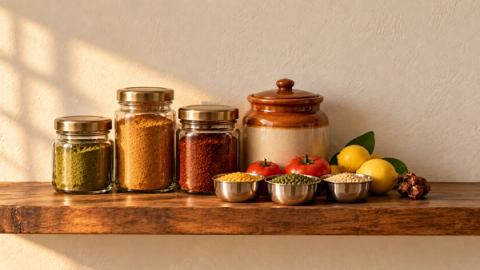
And seeds, in the form my mother and grandmother used: chutney powders. Flaxseed and sesame. Curry leaf (karivepaku) ground with lentils. Moringa leaf with lentils. Coriander seed with lentils. Yellow moong dal (pesara pappu) powder. A leaf we call chennangi aaku, dried and ground. Almost every powder on my shelf is a seed or a leaf ground with lentils, and a spoon on the rice adds to the day without anyone noticing.
Getting the hang of it
I won’t pretend this was easy at the start. Looking at a plate and seeing what is on it, not just whether it is tasty and whether the children will eat it, is a different way of looking. It is like learning any skill. It is hard at the beginning, and as you keep doing it you learn the small things, which dal goes with which green, what to put on the rice, what to keep for the snack, until the plate carries more without looking any different. At first I was counting, and it felt like a task on top of cooking.
There was one more thing I had not expected. Getting protein from dal and rice means eating a fair amount of food, and a plate like that fills you up well before you are done, because of the fiber in it. It is the same fiber that feeds the gut, and that story is in What Is the Gut?. So on a vegetarian plate the protein and the calories have to be looked at together. That was the part that took the longest to learn, and it is the part I still think about most.
For a child it is almost the other way round. A child’s protein number is small, and an ordinary day on a plate like this meets it. What a growing child needs a lot of, for their size, is energy, and the rice, the roti and the ghee are doing that job. So I stopped worrying about the protein on my children’s plates and started making sure there was enough food on them. The numbers are in the article alongside.
But I don’t count any more. Somewhere along the way the counting stopped and the habit stayed. Now I check once in a while, and that is how I learned to plan the week’s meals instead of one dinner at a time.
My answer now
People still ask me where my protein comes from. I still say dal first. Then I keep going.
Dal is just the beginning. For us vegetarians it cannot be the only source, and I learned that it does not have to be. The rest of the plate carries the rest, and the plate my mother served every day was doing the job without anyone calling it protein.
What I had to learn was to put it together on purpose, because a vegetarian plate gets its protein from the whole plate and not from one dish. For an ordinary week, food does all of it. If someone in the house is training for something specific, that is a different question, and one for a doctor or a dietitian rather than a scoop of powder by default.
Protein is usually the first thing people ask a vegetarian about, and it is not the only thing worth asking. Iron, zinc and B12 each have their own answer on a vegetarian plate, and some of those answers are harder than the protein one. Those are coming as their own articles.
How much a child needs, and why the plate has to be built this way, is in the Learning Grove: Protein on a Vegetarian Plate. If this note is where the question came from, that article is the answer.
My plate is not perfect every day, and I have stopped expecting it to be. One plate does not decide the week. If the legume, the green and the curd are there most days, and the children are eating enough, the week is doing its job, and the night the dal was thin or dinner was a slice of pizza is just a night. Life happens, and I let it.
I also know that the kitchen I grew up with ran on something I don’t have. My mother and my grandmother had other hands in the house for the rest of the work, time in the day, and a market down the road. Most of us feeding a family now have none of those, and a great deal else to carry. So this is not a note asking anyone to cook everything at home the way they did. How I keep the plate whole in a week that is nothing like my mother’s is a note of its own, and it is coming. This one asks only one thing: that all the parts of the plate are there, because on a vegetarian plate it is the parts together that make the whole, and when one quietly drops off the whole is less than it looks.
PS: This is a reflection, not medical or nutrition advice. If something about how you or your children are eating is worrying you, please talk to someone who can look at it properly. Every body is different, and so is every kitchen.