Quick take
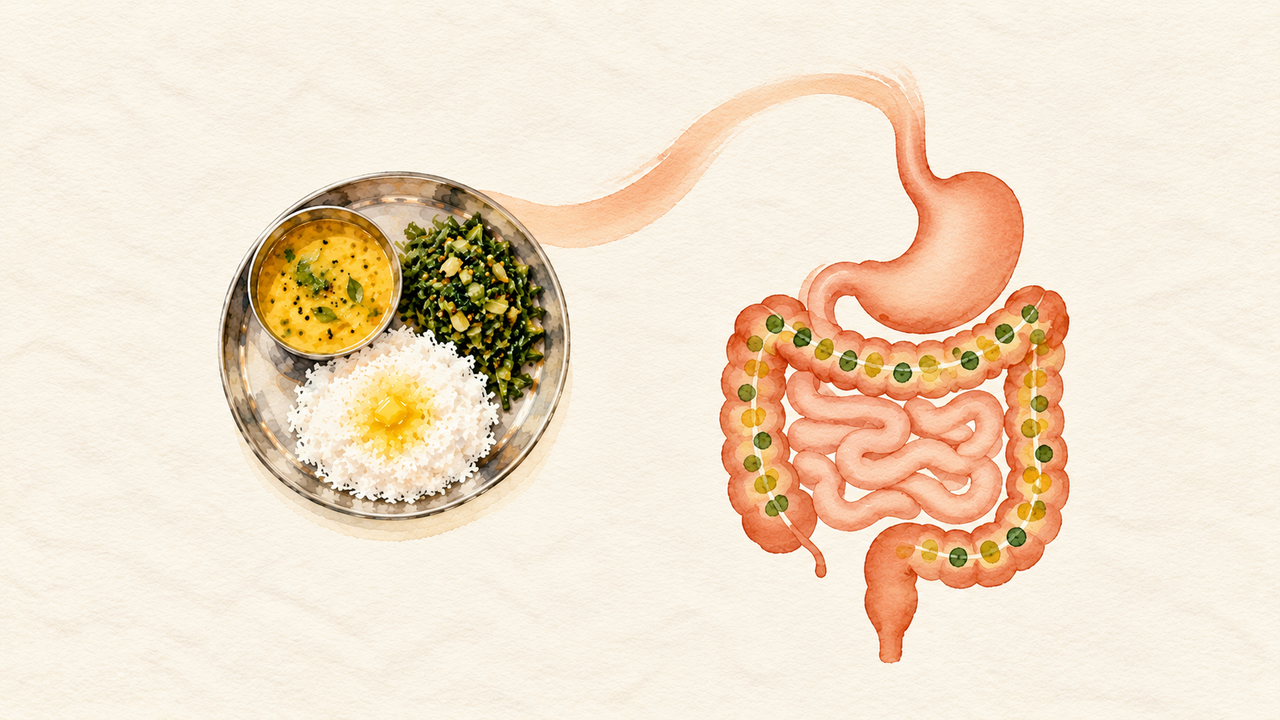
The gut is the path our food takes through the body, and a very large community of microbes that lives near the end of it. Following one ordinary meal down that path shows what feeds us and what feeds them.
A word we hear everywhere
The word "gut" comes up all the time now: gut health, gut-friendly, good for the gut.
We hear the word so often that it has started to sound like a separate organ, or like something too complicated to understand.
The gut is the path our food takes through the body, together with a very large community of microbes that lives near the end of that path.
The easiest way to see both is to follow one ordinary meal.
The path of a meal
The gut is one long tube. In order, it is the mouth, the food pipe, the stomach, the small intestine and the large intestine.1
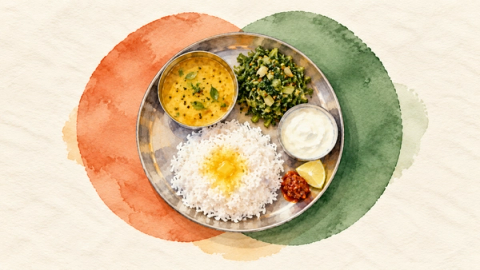
Take a plate of dal, rice and a vegetable. This is what happens to it along the way.1
| Where | What happens there |
|---|---|
| Mouth | The food is chewed and swallowed. |
| Stomach | The food is mixed with digestive juices and passed on a little at a time. |
| Small intestine | The digested food and water are taken into the blood. |
| Large intestine | Water is taken in, and what is left becomes stool. |
By the time the meal leaves the small intestine, the body has taken in what it was able to digest.
What is left is the part we cannot digest: the fibre in the dal, in the vegetable, and in the outer layers of whole grains. That part goes on to the large intestine.2
Who lives at the end of the path
The large intestine is where the microbes are. There are about 38 trillion bacteria in the body, roughly as many as we have cells of our own, and together they weigh about 200 grams.3The bacteria of the gut are what people mean by the gut microbiome.1 Most of them live here, at the end of the path.3
The fibre we could not digest is their food. They ferment it, and what they make from it includes short-chain fatty acids. The body absorbs these. One of them, butyrate, is the main food of the cells that line the large intestine.2 The bacteria also make vitamin K.1
No two guts are the same
The path is the same in all of us, but the community is different from person to person and from one part of the world to another. When the gut bacteria of healthy Indian adults were mapped, they formed a group of their own, apart from the other populations they were compared with.4
The community also follows the food. People from the same background who eat differently carry a different mix of bacteria.5
So what is the gut?
The gut is a path that takes in what we can digest, and a community at the end of that path that lives on what we cannot.
So the same plate feeds us and feeds the microbes. What Is Food? looks at a plate both ways.
In the kitchen
What reaches the large intestine is decided by what gets cooked.
Fibre reaches the large intestine. It comes from dal, vegetables, whole grains and millets. Some starch escapes digestion and gets there too.2So do plant compounds that are not absorbed higher up.6
Curd is eaten just as it set, so its bacteria are still alive when we eat it.7 A separate article on fermented foods is coming.
Nourishfully Insight: Whatever we cook feeds us first. What we cannot digest goes on to feed the microbes in our gut.
PS: This guide is for education. It does not replace personal medical or nutrition advice. Every body is different, and so is every kitchen.
References
Each source is labelled by the kind of evidence it is.
- 1
National Institute of Diabetes and Digestive and Kidney Diseases. Your Digestive System & How it Works. NIDDK, US National Institutes of Health; last reviewed December 2017.
- 2
FAO/WHO. Carbohydrates in Human Nutrition: Report of a Joint FAO/WHO Expert Consultation, Rome, 14–18 April 1997. FAO Food and Nutrition Paper 66. FAO; 1998. Section: Physiological effects of dietary fibre.
- 3
Sender R, Fuchs S, Milo R. Revised estimates for the number of human and bacteria cells in the body. PLoS Biology. 2016;14(8):e1002533.
- 4
Dhakan DB, Maji A, Sharma AK, Saxena R, Pulikkan J, Grace T, Gomez A, Scaria J, Amato KR, Sharma VK. The unique composition of Indian gut microbiome, gene catalogue, and associated fecal metabolome deciphered using multi-omics approaches. GigaScience. 2019;8(3):giz004.
- 5
D'Aloisio LD, Ballal M, Ghosh S, Haskey N, Abulizi N, Karimianghadim R, Liu C, Sruthi P, Nagarajan L, Vasudevan S, Shetty V, Purandare M, Bhaumik U, Howlader DR, Pakpour S, Barnett J, Gibson DL. The adoption of a westernized gut microbiome in Indian Immigrants and Indo-Canadians is associated with dietary acculturation. npj Biofilms and Microbiomes. 2025;11:151.
- 6
Ray SK, Mukherjee S. Evolving Interplay Between Dietary Polyphenols and Gut Microbiota—An Emerging Importance in Healthcare. Frontiers in Nutrition. 2021;8:634944.
- 7
Marco M. Do fermented foods contain probiotics? International Scientific Association for Probiotics and Prebiotics (ISAPP). Published January 10, 2022; updated June 21, 2025.