Quick take
Once a meal is eaten, it makes two stops: at the first it feeds us, and what is left travels on and feeds the gut. Reading a plate both ways shows what a meal is doing, and an ordinary plate of dal and rice answers both.
A child's question
What is food?
It sounds like something a five-year-old asks at the table. Most of us would answer with a list: rice, dal, vegetables. Or with what school taught us: carbohydrates, proteins, vitamins. Or with the two words we hear most often now, healthy and unhealthy.
Before any of those, food is what a family remembers. It is the smell of a tadka from the next room and the plate somebody made for us without being asked. Nothing in this article replaces that.
But there is also a plainer answer, and it is a useful one.
Once a meal is eaten, it travels one path through the body and makes two stops. At the first, what we can digest is taken in, and becomes our energy and our building material. What we cannot digest travels on to the second, the large intestine, where the microbes living there ferment it.1
So every plate can be read twice. Once for what it gives us. Once for what it sends on.
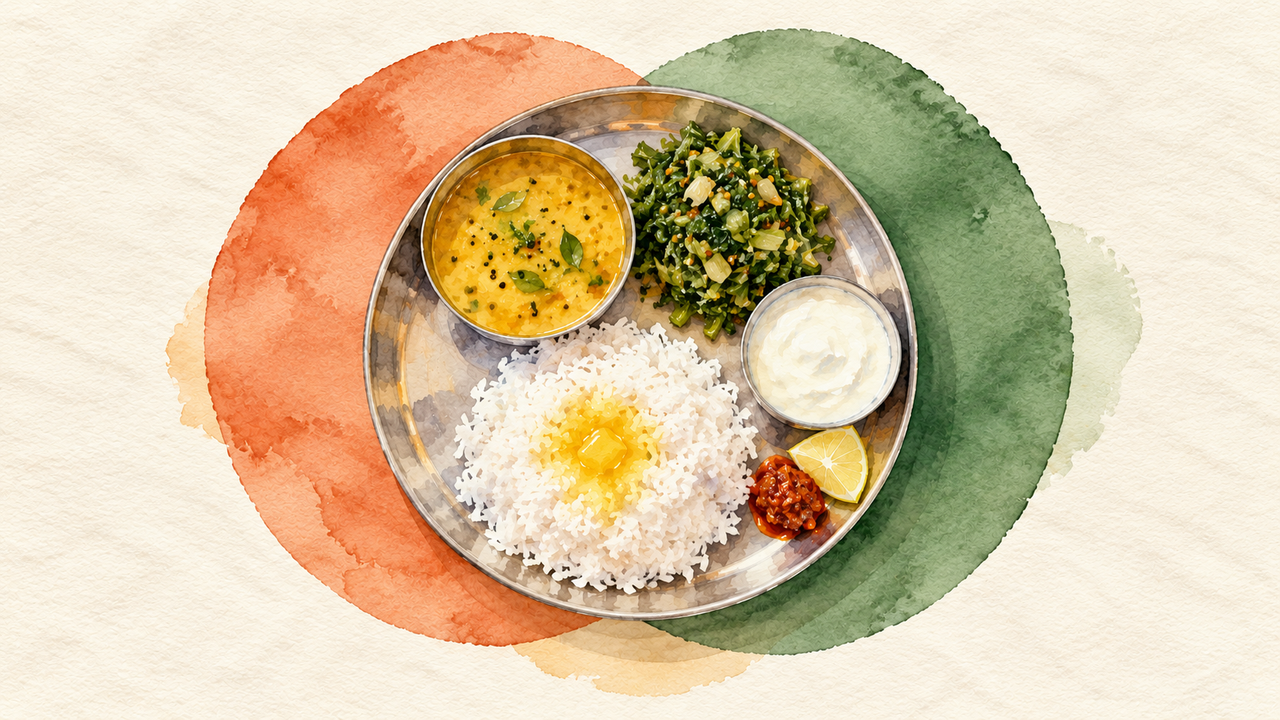
One plate, read twice.
Why one way of looking is not enough
Most of what we were taught about nutrition uses only the first reading. Charts and labels count what the body takes in: so much protein, so much iron, so many calories.
Gut health, when it comes up, usually reaches us another way: as words and as products.
The words are probiotic, prebiotic, microbiome, gut-friendly. The products are capsules, powders to stir into water, fibre gummies, small bottled drinks, and test kits that arrive in the post.
None of it looks much like dinner.
Whoever feeds a family is already holding both at once, because they are the same meal. The dal that brings protein to a growing child is also carrying fibre past her and onward. Looking through only one lens, we see half of what the pot is doing.
The plate was never doing just one job.
The body lens
The body lens asks what a meal gives each person who eats it. It asks two things.
Did each person get enough?
There's no single number for "enough." It changes with age, with being a man or a woman, with pregnancy, and with how much a body moves.2
Take iron, for example. The recommended allowance for a woman is 29 mg a day, and for a man 19.3 Both of them may be eating from the same pot of dal, but that dal has to do a lot more for her than it does for him.
So this lens is read one person at a time. A household average would hide the very thing we are looking for.
What else is on the plate matters too. A squeeze of lemon helps the body take up the iron in the dal. A cup of tea with the meal holds it back.2
And bodies differ in what sits well with them. That belongs to this lens too.
How does the meal land?
The second question is about pace. The same food can reach the blood in a rush or more slowly, depending on what is eaten with it.
When half the rice on a plate makes room for dal, blood sugar rises about a fifth less.4 Rice that shares its plate with dal lands more gently than rice alone.
Salt comes in here as well. Most of us do better with less of it,2 and that includes the pickle on the side.
Enough is one question. How it arrives is another.
The gut lens
The gut lens asks what a meal sends on.
The fibre in dal, vegetables and whole grains is the part of food our own bodies cannot break down. It reaches the large intestine, where the microbes living there ferment it. What they make from it includes short-chain fatty acids, butyrate among them.1
Whether that fibre is on the plate makes a difference. When people eat their grains whole instead of refined, their gut microbes leave more butyrate behind, and their bowels move more often.5 It is one reason at least half the grain we eat is better whole, millets included.2
Then there are the fermented foods, and our kitchens are full of them: curd, buttermilk, the batter for idli and dosa. But they don't all reach the table the same way. Curd is eaten just as it set, so its bacteria are still alive when we eat it. Idli batter goes into the steamer, and they don't survive the heat.6 So the curd brings live cultures to the plate. The idli brings something else: the work the fermenting already did in the batter, which leaves its iron and zinc easier for the body to take up.7
The first lens had to be read one person at a time. This one can be read for the whole table at once, because everyone eats from the same pot. How much fibre there is, whether the grain is whole or polished, which fermented foods show up: all of that is decided by what gets cooked.
What we cannot digest is not wasted. It is someone else's meal.
One plate, read twice
Take the most ordinary plate in many of our homes: rice, dal, a vegetable, curd, a little ghee, and something sharp on the side.246
| On the plate | Through the body lens | Through the gut lens |
|---|---|---|
| Rice | Carbohydrate, the plate's main source of energy. Lands more gently when dal shares the plate. | Polished rice has lost its outer layers. Whole grains and millets carry more through. |
| Dal | Protein, with fibre and micronutrients. Eaten with rice, the amino acids of the two complement each other. It also softens how the rice lands. | Fibre that travels on. |
| Vegetable | Vitamins and minerals. | More fibre. |
| Curd | Calcium in a form the body absorbs well, and protein. | Live cultures, because it is eaten uncooked. |
| Ghee or oil | Carries the fat-soluble vitamins and carotenes, and helps the body absorb them. | Doesn't add much for the gut. |
| Lemon and pickle | Lemon helps the iron in the dal. Pickle brings salt. | Doesn't add much for the gut. |
Nothing on the plate fills both columns equally. The rice does little for the gut. The ghee does nothing for it. The curd is not there for fibre.
The plate as a whole fills both. Nobody designed it with two lenses in mind. It was handed down, meal by meal, by people who cooked it because it worked.
Nourishfully Insight: No single food answers both lenses. A plate can.
What comes next
The two lenses tell us what a plate is doing. Three questions follow from them.
The first is where. What is the gut, and who lives there? That is the subject of What Is the Gut?
The second is when. Not everything on this page has to arrive today. Some nutrients are due daily, some settle over a week, and some the body has been holding for years. That is the subject of The Rent, the Rhythm, and the Reserve.
The third is how. Soaking, sprouting, fermenting and cooking each change what a food gives, through both lenses. That is the subject of Good for What?
For now, the child's question has a fuller answer than a list.
Food is care first. And then it is two things at once: what feeds us, and what we pass along.
So, looking at tonight's plate: what is it giving each of us, and what is it sending on?
PS: This guide is for education. It does not replace personal medical or nutrition advice. Every body is different, and so is every kitchen.
References
Each source is labelled by the kind of evidence it is.
- 1
FAO/WHO. Carbohydrates in Human Nutrition: Report of a Joint FAO/WHO Expert Consultation, Rome, 14–18 April 1997. FAO Food and Nutrition Paper 66. FAO; 1998. Section: Physiological effects of dietary fibre.
- 2
ICMR-National Institute of Nutrition. Dietary Guidelines for Indians. ICMR-NIN; 2024.
- 3
ICMR-National Institute of Nutrition. A Brief Note on Nutrient Requirements for Indians, the Recommended Dietary Allowances (RDA) and the Estimated Average Requirements (EAR). ICMR-NIN; 2020.
- 4
Moravek D, Duncan AM, VanderSluis LB, Turkstra SJ, Rogers EJ, Wilson JM, Hawke A, Ramdath DD. Carbohydrate replacement of rice or potato with lentils reduces the postprandial glycemic response in healthy adults in an acute, randomized, crossover trial. Journal of Nutrition. 2018;148(4):535–541.
- 5
Procházková N, Venlet N, Hansen ML, Lieberoth CB, Dragsted LO, Bahl MI, Licht TR, Kleerebezem M, Lauritzen L, Roager HM. Effects of a wholegrain-rich diet on markers of colonic fermentation and bowel function and their associations with the gut microbiome: a randomised controlled cross-over trial. Frontiers in Nutrition. 2023;10:1187165.
- 6
Marco M. Do fermented foods contain probiotics? International Scientific Association for Probiotics and Prebiotics (ISAPP). Published January 10, 2022; updated June 21, 2025.
- 7
Hemalatha S, Platel K, Srinivasan K. Influence of germination and fermentation on bioaccessibility of zinc and iron from food grains. European Journal of Clinical Nutrition. 2007;61(3):342–348.