Quick take
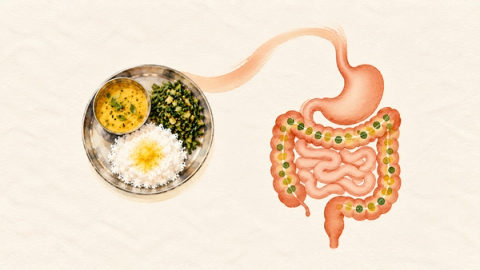
The body needs some nutrients every day, can balance others over a few weeks, and stores some for years. Once we know which is which, a balanced diet looks very different.
The seven o'clock question
Did they get enough protein today? Was there any iron in that? Is one vegetable enough?
Most of us have stood at the stove asking these questions. It usually happens around seven in the evening, when the rice is done and the dal has turned out thinner than we wanted. And most days it ends with the feeling that today was not enough.
There is a reason we feel this way. We learned nutrition from a chart: a list of vitamins and minerals with a number next to each one. The chart doesn't say how often each number has to be met. So we assume all of it is due every single day.
But the body runs on three different clocks.
Three clocks
Think about how a household handles money.
There is the rent. It has to be paid on time, every time, and we can't make it up next month. There is the weekly shopping. Some weeks we spend more and some weeks less, and over the month it evens out. And there are the savings. We build them slowly and touch them rarely.
Nutrients work the same way. A few the body cannot store at all. Some it holds for a few weeks. Some it holds for years. Nobody teaches us this difference, so we treat every nutrient like rent, and then feel we are behind on all of them.
The recommended amounts were always meant as averages. Each one is a goal for what we eat averaged over time, and it is expected that some days will be higher and some lower.123
How long "over time" is depends on the nutrient, and the rest of this article is about that. One caution first. If someone's intake stays well below the recommended amount, that can be a reason to get tested.2
Averaging also doesn't make the total any smaller. Seven thin days in a row make a thin week.
One plate was never the unit of measurement. A week is a fairer window, and a human-sized one.4
The Rent: what today actually asks for
Only three things are due every day, and they are simpler than we might expect.
Water. We lose water all day long, through skin and breath as well, even when we are sitting still. Babies go through water far faster for their size than adults do,5so a little one runs short on a hot afternoon long before the grown-ups do.
Something to run on. The liver stores enough glucose to carry us through the night. By around twenty-four hours without food that store is used up, and the body turns to its fat and protein instead.6So this store covers about a day.
Protein. There is a lot of worry about protein, but the picture is gentler than that. The body has no store for protein the way it has one for iron or B12. Whatever protein it doesn't need for building and repair, it uses for energy instead.7 What it does keep is a pool of amino acids, the building blocks of protein: a working supply that it draws from and tops up all through the day.8 And it recycles. Every day the body takes apart and rebuilds several times more protein than we eat.7
So protein is something to look at across the whole day. One thin bowl of dal at dinner doesn't decide it.
The Rhythm: what the week takes care of
The second group is the nutrients the body can hold for a few weeks.
Vitamin C is a good example. The body keeps a pool of it and uses up only about 3% of that pool each day. So even with no vitamin C coming in at all, the pool lasts at least a month.9Thiamin, or vitamin B1, runs down faster. About half of the body's supply is gone in nine to eighteen days.10
So missing the lemon on the dal one Tuesday does no harm. The trouble starts when a whole month goes by with nothing fresh, sour or raw.
So it helps to rotate what we cook. If the dal, the vegetable and the sour thing keep changing, nothing stays missing for weeks.
Vitamin D is the exception on this clock. There is very little of it naturally in vegetarian food. The body makes it from sunlight, and makes less of it when we stay indoors, keep the skin covered or have darker skin. What it makes lasts only a few weeks in the blood.11So for vitamin D, rotating food is not enough, and a test is the way to know. A separate article on vitamin D is coming.
Seven ordinary days do more than one perfect Tuesday.
The Reserve: what the body has already put away
The third group is the nutrients the body stores for months or years. One week makes very little difference to these stores.
Vitamin B12. The body keeps a store of it and loses only a tiny part of that store each day. A full store can last for years.12
But that is only if the store was full to begin with. B12 is found naturally only in foods of animal origin, milk and curd included. So in a vegetarian family the store may never have been full.13 B12 is not one to wait and watch. It is worth asking a doctor about. A separate article on B12 is coming.
Folate is stored too, about half of it in the liver. The one big exception is early pregnancy, when the need goes up and cannot wait. So folic acid is advised from before pregnancy through its first months. A good week of food does not replace it.14
Vitamin A is stored mostly in the liver, and that store comes down slowly, over months.15 Iodine is held mostly in the thyroid.16
Iron is the one to be careful with. The body does keep a store of iron, but it also loses a little every day, and women who have periods lose more.17 Food has to make up for that loss. When it doesn't, the store slowly runs down. So iron belongs in this group only for someone who already has a good store. For women who have periods, in pregnancy, and for growing children, iron is much closer to rent. It is closer still on a mostly vegetarian plate, because less of the iron is absorbed.18 Iron stores can run low before anemia shows, and a blood test is the way to find out. Ferritin is the measure of the body's iron stores.18 A separate article on iron is coming.
Calcium is the biggest store of all. More than 99% of the body's calcium is in the bones and teeth.19 So the skeleton holds us up and is also the body's calcium store.
A reserve is like savings. It is built a little at a time, long before it is needed.
The three clocks, side by side
| Clock | What is on it | What it means in the kitchen |
|---|---|---|
| The Rent: due every day | Water, energy, protein | Everyday meals usually cover it |
| The Rhythm: settles over weeks | Vitamin C, thiamin (B1), vitamin D | Rotate what we cook through the week. Vitamin D needs a test |
| The Reserve: months to years | Vitamin B12, folate, vitamin A, iodine, iron, calcium | Built by habits kept up for years. B12 and iron need a test |
One thing to remember: these are averages, and no two bodies are the same. So read the table to see which nutrient is on which clock. It is not a countdown for your own body.
A reserve isn't a free pass
Having a store does not mean we can stop thinking about that nutrient. Take calcium.
When there isn't enough calcium in the food, the calcium level in the blood still stays normal. It stays normal because the body takes the calcium it needs out of the bones.20
So a normal blood test does not always mean there was enough calcium in the food. The bones may have been making up the difference.
Iron is another. Its store can be used up before anemia shows.18 A big store does not mean we have plenty to spare.
We all start from different places
Every body is different. How much each of us has stored depends on how we have eaten over the years, on our age, on pregnancies and illnesses, and on how we live. Two people can eat exactly the same food this week and still start from very different places.
So this article is not medical advice, and it cannot tell you where your own levels stand. If something doesn't feel right, or if you are pregnant, breastfeeding or eating a fully plant-based diet, please talk to your doctor. A blood test will tell you more than any article can.
The point of this article is simpler. We don't have to panic about every nutrient on every plate at every meal. Some things are needed today, many can wait for the week, and some the body has already put away.
Why traditional kitchens already did this
A kitchen that cooks by the market, the season and what people feel like eating rotates on its own. The dal changes when the greens change, because the leaf going into the pot decides which dal goes with it. There is always something sour, and it is rarely the same one two days running, because there are several in the house. There are four or five jars of chutney powder on the shelf, not one. And curd is always there, so nobody has to remember it.
Nobody planned any of this around nutrients. But it puts variety on the table across the week, and that is exactly what the three clocks need.
The variety comes from the shelf. If there are four sour things, four chutney powders and several dals in the house, the week rotates by itself, and nobody has to keep track.
To be fair, those kitchens usually had more hands, more time and a market to go to every day. Most of us don't have that now. The idea still works for us. It just takes more effort than it did for them, and that is not our failing.
What it takes now is a little planning. In those kitchens the market and the season did the rotating. Today we can get almost everything all year round, so nothing makes us change what we cook. And with the schedules we keep, we go back to whatever is easiest. So we have to do it on purpose. If we decide the week's dals and vegetables before we shop, the variety is already in the house when we stand at the stove at seven.
So, in practice:
- Rotate the dal as well as the vegetable. Each dal brings its own mix of protein, fiber and minerals, and over a week they add up.
- Keep something sour on the plate through the week. Lemon, tomato, amla when it is in season. Vitamin C needs to come often. It doesn't need to be counted every day.
- Keep the reserve foods regular. Sesame, finger millet (ragi), greens and curd for calcium. For B12 on a fully plant-based diet, talk to your doctor; a heavier dinner won't fix it. These stores are built by habits kept up for years.
- Look at the week as a whole. Five or six vegetables, three or four dals, something fermented, something raw, something green. It matters very little which day each one came on.
Nourishfully Insight: One dish can't be balanced, and neither can one day. Balance comes from what we eat over a week, so the week is what to look at.
So what has this week been made of?
If you cook for your family, you have probably felt that you are not doing it well enough. Almost everyone has.
Tonight's plate only has to be one part of a complete week. If this week had a few different dals, a handful of vegetables, something fresh, something fermented and something green, then the week has done its work.
So the question to ask at seven o'clock is what this week has been made of.
PS: This guide is for education. It does not replace personal medical or nutrition advice. Every body is different, and so is every kitchen.
References
Each source is labelled by the kind of evidence it is.
- 1
ICMR-National Institute of Nutrition. Dietary Guidelines for Indians. ICMR-NIN; 2024. Page 8.
On what recommended intakes mean
- 2
Institute of Medicine (US). Uses of Dietary Reference Intakes. In: Dietary Reference Intakes for Thiamin, Riboflavin, Niacin, Vitamin B6, Folate, Vitamin B12, Pantothenic Acid, Biotin, and Choline. National Academies Press; 1998.
- 3
FAO/WHO. Human Vitamin and Mineral Requirements, Chapter 1: Introduction. FAO; 2002.
- 4
NHS. The Eatwell Guide. Page last reviewed 29 November 2022.
Water, energy and protein
- 5
National Research Council (US). Recommended Dietary Allowances, 10th ed. Water and Electrolytes. National Academies Press; 1989.
- 6
Sanvictores T, Casale J, Huecker MR. Physiology, Fasting. In: StatPearls. StatPearls Publishing; last updated July 24, 2023.
- 7
National Research Council (US). Recommended Dietary Allowances, 10th ed. Protein and Amino Acids. National Academies Press; 1989.
- 8
WHO/FAO/UNU. Protein and Amino Acid Requirements in Human Nutrition: Report of a Joint WHO/FAO/UNU Expert Consultation. WHO Technical Report Series 935. World Health Organization; 2007. Section 2.7, pages 27 to 28.
Vitamins
- 9
FAO/WHO. Human Vitamin and Mineral Requirements, Chapter 6: Vitamin C. FAO; 2002.
- 10
Institute of Medicine (US). Thiamin. In: Dietary Reference Intakes for Thiamin, Riboflavin, Niacin, Vitamin B6, Folate, Vitamin B12, Pantothenic Acid, Biotin, and Choline. National Academies Press; 1998.
- 11
NIH Office of Dietary Supplements. Vitamin D: Fact Sheet for Health Professionals. Updated June 27, 2025.
- 12
Institute of Medicine (US). Estimation of the Period Covered by Vitamin B12 Stores. Appendix to Dietary Reference Intakes for Thiamin, Riboflavin, Niacin, Vitamin B6, Folate, Vitamin B12, Pantothenic Acid, Biotin, and Choline. National Academies Press; 1998.
- 13
NIH Office of Dietary Supplements. Vitamin B12: Fact Sheet for Health Professionals. Updated July 2, 2025.
- 14
NIH Office of Dietary Supplements. Folate: Fact Sheet for Health Professionals. Updated November 30, 2022.
- 15
Institute of Medicine (US). Vitamin A. In: Dietary Reference Intakes for Vitamin A, Vitamin K, Arsenic, Boron, Chromium, Copper, Iodine, Iron, Manganese, Molybdenum, Nickel, Silicon, Vanadium, and Zinc. National Academies Press; 2001.
Minerals
- 16
NIH Office of Dietary Supplements. Iodine: Fact Sheet for Health Professionals. Updated November 5, 2024.
- 17
Institute of Medicine (US). Iron. In: Dietary Reference Intakes for Vitamin A, Vitamin K, Arsenic, Boron, Chromium, Copper, Iodine, Iron, Manganese, Molybdenum, Nickel, Silicon, Vanadium, and Zinc. National Academies Press; 2001.
- 18
NIH Office of Dietary Supplements. Iron: Fact Sheet for Health Professionals. Updated September 4, 2025.
- 19
NIH Office of Dietary Supplements. Calcium: Fact Sheet for Health Professionals. Updated June 22, 2026.
- 20
Institute of Medicine (US). Calcium. In: Dietary Reference Intakes for Calcium, Phosphorus, Magnesium, Vitamin D, and Fluoride. National Academies Press; 1997.