Quick take
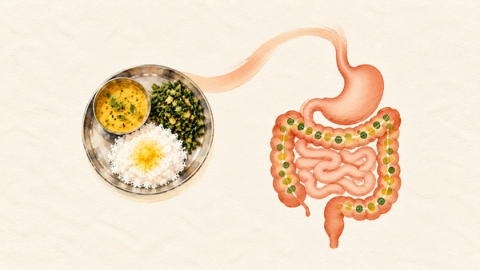
The gut follows the food, and how far it changes depends on how far the plate moves. So the dal and the vegetables we keep on the plate most days count, even in a week that looks nothing like our mothers’. This article is what has been measured behind that.
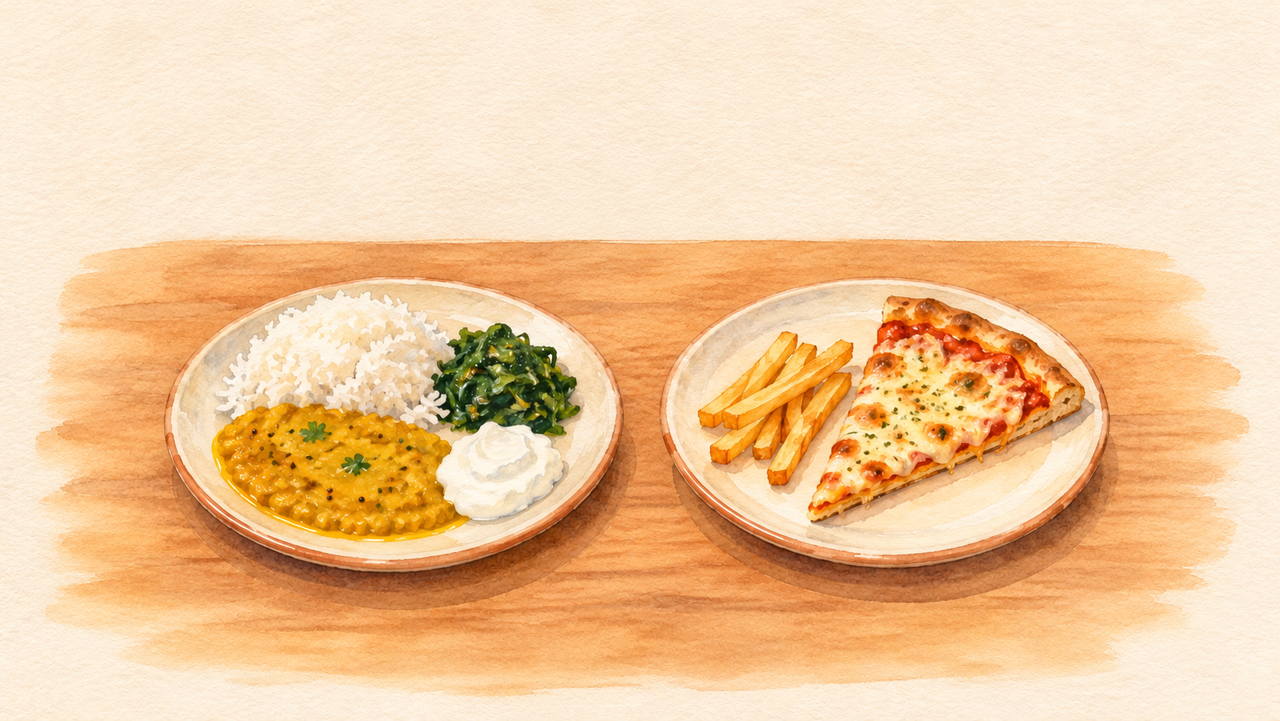
Two plates, two guts
I am a first-generation immigrant, and my children were born here. The plate I grew up on and the plate I put in front of them are not the same plate, and the thought I keep coming back to is what that does to a gut. My gut moved with me. Theirs never had the first plate at all.
Two questions sit under that thought. Why are guts different from one person to the next? And why do they change?
And behind those is the one families like ours actually ask. The children eat between two plates, and ours has moved too. Does the gut notice? And is it too late to do anything about it?
The short answer is that the community of microbes in the gut follows the food. What Is the Gut? ended on that line. This article is what it means: how the community follows, how fast, how far, and what comes back.
Why guts are different
The microbes in the large intestine live on what we cannot digest: fiber, from dal, vegetables, whole grains and millets, and the starch that escapes digestion. Which microbes thrive depends on which of those foods arrive, so a gut is shaped around the plate it has been fed.
That shows as soon as guts are compared. When the gut bacteria of healthy Indian adults were mapped, they formed a group of their own, apart from the other populations they were compared with.1 Across a thousand adults in fourteen places in India, the most common bacterium was one species that lives on plant fiber, Prevotella copri, now called Segatella copri, at about four in ten of the bacteria counted.2 Bacteria are named in two parts, the group first and the kind second; How Gut Bacteria Are Named is a short guide to reading the names in this article. In tribal communities it ran from a quarter to nearly half.3 In a North American or European gut a different group, Bacteroides, takes the lead.4
The difference is not only between India and the West. Within India, adults in Bhopal, where most people are vegetarian, had more of the fiber specialist. Adults in Kerala, who eat rice, meat and fish, had more Bacteroides, the same group that leads in Western guts.1 The plate differed, and so did the gut. Neither is the better gut. Each one is the community that the plate in front of it can feed.
Why they change
When the food that feeds one group of bacteria stops arriving, that group’s numbers fall within days, and whichever group the new food feeds rises in its place.5 The old bacteria are not pushed out by anything in the new food. Their food is gone, so they decline. That is the mechanism this article follows. Everything below is the same thing over a longer time.
What the bacteria make changes with them. The fiber specialists ferment fiber into short-chain fatty acids, the compounds that What Is the Gut? described, and when fiber leaves the plate those products fall within the same few days.5
The bacteria that remain still have to eat. In mice fed no fiber, some of them turn to the only sugars left, the mucus layer that lines the colon, and that layer thins.6 That is a mouse finding and describes a mechanism, not a measurement in people. But it makes the same point: the bacteria do not go quiet when the fiber stops, they eat something else instead.
None of this needs a move across the world. In a farming community in India, the same adults were sampled in summer, autumn and winter, and their gut community shifted with the season between two community types.7 The gut is remade, slowly, by whatever arrives.
Food is not the only thing that arrives. When women who moved from Thailand to the US were followed, their food diaries explained part of the change in their gut and not all of it.4 The place we live and how much of the outdoors reaches us, the medicines we take, the people and animals we share a house with, stress, and how we were born all leave their mark too. A separate article, What Shapes a Gut, is coming. This one follows the food, because of everything that shapes the gut, the plate is the part that is in our hands every day.
How far the change goes
Over days, the balance tips. Over years, the question is how far it tips, and that has been measured in people moving between food cultures, including Indian families in Canada.548
| Over | What moves | Measured in |
|---|---|---|
| Days | The balance of bacteria tips toward whichever group the new food feeds. | Adults switched between an all-plant and an all-animal diet. |
| Months | Bacteroides begins displacing the fiber specialists. | Women from Thailand in their first year in the US. |
| Years | The further the diet has moved, the further the community has moved. | Indians in India, Indian immigrants in Canada, and Indo-Canadians, compared side by side. |
| A generation | The children of immigrants are furthest from the gut of the country they came from. | Both studies above. |
The Canadian study is the closest to us, and it shows the change as a line. The fiber specialist was most common in people in India, less common in those who moved to Canada as adults, less again in Indo-Canadians raised there, and least in Euro-Canadians. The bacterial enzymes that break down plant fiber ran along the same line. So did the food: ultra-processed food was about 12 percent of calories for the group in India and about 61 percent for the Indo-Canadians, who also ate the least fiber of any group.8
The paper calls this a transitional microbiome, no longer the Indian community and not yet the Canadian one. How far along the line it sat tracked how far the plate had moved.
One more thing, because it goes against what we usually hear about the gut. By the usual measure of how many different kinds of bacteria a gut holds, the group in India came out lowest and the Euro-Canadians highest.8 That sounds backwards, but the authors explain it. The Indian gut is dominated by one fiber specialist, the species Prevotella copri (now Segatella copri), in all four of the subtypes the study measured, with more of the genes for breaking down plant fiber. When one species takes up that much room, the rarer ones are harder to detect, and the count comes out low. The authors say themselves that this measure alone is not a reliable marker of how western a gut has become, or of health.8 This article is about that specialist and whether it is still there, not about the count.
Does it come back?
For the change in days, yes. The balance that tipped within a day of one diet reaching the gut was back where it started two days after that diet ended.5Days of one kind of food move it, and days of the other move it back.
For the change over years, the migration studies did not measure the return. They compared groups at one point in time, or followed people in one direction only.
The longer question has been tested in mice. Mice carrying human gut bacteria were kept on a low-fiber diet for several generations. In the first generation, much of the change reversed when fiber was put back on the plate. By the fourth generation, many did not come back with fiber alone. They came back only when the missing bacteria were given back as well, together with the fiber.9 This is a mouse study, and four mouse generations are not four human ones. But it is the clearest test so far of a simple idea: keeping a community fed is easier than rebuilding it.
In the kitchen
Put the pieces together and the picture is a steady one.
The gut follows the plate, and at every timescale the measured change tracked how much the plate had moved, not whether it had moved at all. A plate that is 61 percent ultra-processed food has moved a long way. A plate with dal and vegetables on it most nights and pizza on Friday has not. Nobody has measured a point where the plate stops counting, and nothing above suggests there is one. What the studies measured was a gradual change that followed the diet.
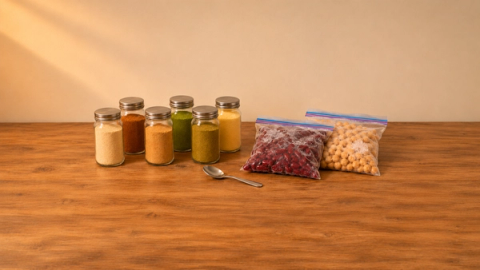
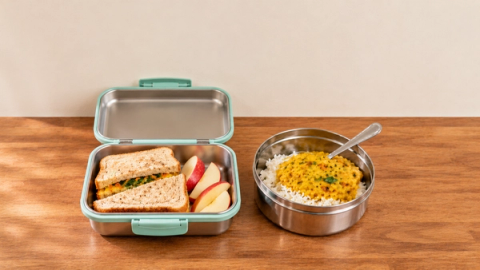
That is why the earlier articles here were about the parts: the dal or the legume, the green, the curd, the podi on the rice. Each one is fiber or a ferment arriving in the large intestine, and each day it arrives is a day the fiber specialists are fed. The dal does more than one job on that plate, since it brings protein and resistant starch along with its fiber, but for the microbes the vegetables count just as much. How I Keep the Plate Whole is the practical half of this article: how those parts stay in the house in a week that is nothing like our mothers’.
The questions that sent me looking for all of this are in The Questions I Keep Coming Back To.
So, to the two questions. Guts are different because plates are different, between countries and within one. They change because the community eats what arrives, and not only that, but the food is the part that changes within days when we change it. How far it goes depends on how far the plate goes, and the plate is the one part of this that is in our hands.
Nourishfully Insight: The gut is not asking for the old plate or nothing. It is asking whether the fiber (the dal and the vegetables) is still there most days.
A gut condition, or a child whose digestion is worrying you, is a different question from the one here, and the person to take it to is your doctor or a dietitian.
PS: This guide is for education. It does not replace personal medical or nutrition advice, and it does not say that any diet causes or prevents any condition. Every body is different, and so is every kitchen.
References
Each source is labeled by the kind of evidence it is.
Indian guts
- 1
Dhakan DB, Maji A, Sharma AK, Saxena R, Pulikkan J, Grace T, Gomez A, Scaria J, Amato KR, Sharma VK. The unique composition of Indian gut microbiome, gene catalogue, and associated fecal metabolome deciphered using multi-omics approaches. GigaScience. 2019;8(3):giz004.
The Indian cluster; Bhopal vs Kerala
- 2
Dubey AK, Uppadhyaya N, Nilawe P, Chauhan N, Kumar S, Gupta UA, Bhaduri A. LogMPIE, pan-India profiling of the human gut microbiome using 16S rRNA sequencing. Sci Data. 2018;5:180232.
Prevotella copri 0.391, the top organism (Table 1)
- 3
Ebel ER, Kulkarni AS, Mongad DS, Olm MR, Devi SI, Mir BA, et al. Gut microbiomes of tribal communities in India vary with dairy and grain consumption. Gut Microbes. 2026;18(1):2694242.
Segatella copri at a mean 25–47%
Migration
- 4
Vangay P, Johnson AJ, Ward TL, Al-Ghalith GA, Shields-Cutler RR, Hillmann BM, Lucas SK, Beura LK, Thompson EA, Till LM, Batres R, Paw B, Pergament SL, Saenyakul P, Xiong M, Kim AD, Kim G, Masopust D, Martens EC, Angkurawaranon C, McGready R, Kashyap PC, Culhane-Pera KA, Knights D. US immigration westernizes the human gut microbiome. Cell. 2018;175(4):962–972.e10.
Longitudinal sub-study of 19; diet explained 16.8% of the variation
How fast the gut follows the food
- 5
David LA, Maurice CF, Carmody RN, Gootenberg DB, Button JE, Wolfe BE, Ling AV, Devlin AS, Varma Y, Fischbach MA, Biddinger SB, Dutton RJ, Turnbaugh PJ. Diet rapidly and reproducibly alters the human gut microbiome. Nature. 2014;505(7484):559–563.
Controlled feeding study, crossover, five days on each diet
What the microbes eat when the fiber stops
- 6
Desai MS, Seekatz AM, Koropatkin NM, Kamada N, Hickey CA, Wolter M, Pudlo NA, Kitamoto S, Terrapon N, Muller A, Young VB, Henrissat B, Wilmes P, Stappenbeck TS, Núñez G, Martens EC. A dietary fiber-deprived gut microbiota degrades the colonic mucus barrier and enhances pathogen susceptibility. Cell. 2016;167(5):1339–1353.e21.
Mechanism only; mice
The seasons
- 7
Jeyaram K, Lahti L, Tims S, Heilig HGHJ, van Gelder AH, de Vos WM, Smidt H, Zoetendal EG. Fermented foods affect the seasonal stability of gut bacteria in an Indian rural population. Nat Commun. 2025;16:771.
Migration
- 8
D’Aloisio LD, Ballal M, Ghosh S, Haskey N, Abulizi N, Karimianghadim R, Liu C, Sruthi P, Nagarajan L, Vasudevan S, Shetty V, Purandare M, Bhaumik U, Howlader DR, Pakpour S, Barnett J, Gibson DL. The adoption of a westernized gut microbiome in Indian Immigrants and Indo-Canadians is associated with dietary acculturation. npj Biofilms Microbiomes. 2025;11:151.
P. copri clades; ultra-processed food 12% vs 61%; diversity
Keeping against rebuilding
- 9
Sonnenburg ED, Smits SA, Tikhonov M, Higginbottom SK, Wingreen NS, Sonnenburg JL. Diet-induced extinctions in the gut microbiota compound over generations. Nature. 2016;529(7585):212–215.