Quick take
The articles here name bacteria the way scientists do, in two italic words. This is how to read those names, what changes when a name changes, and what "subtypes" and "strains" mean.
Two words
Every bacterium has a two-part name. The first word is the group it belongs to, called the genus, and the second is the kind within that group, called the species. Segatella copri is the species copri in the genus Segatella. Both words are written in italics, the first with a capital letter. After the first mention, the first word is often shortened: S. copri.
When an article uses one word on its own, Bacteroides, say, it means the whole group, every species in it. When it uses two words, it means one kind.
The full address
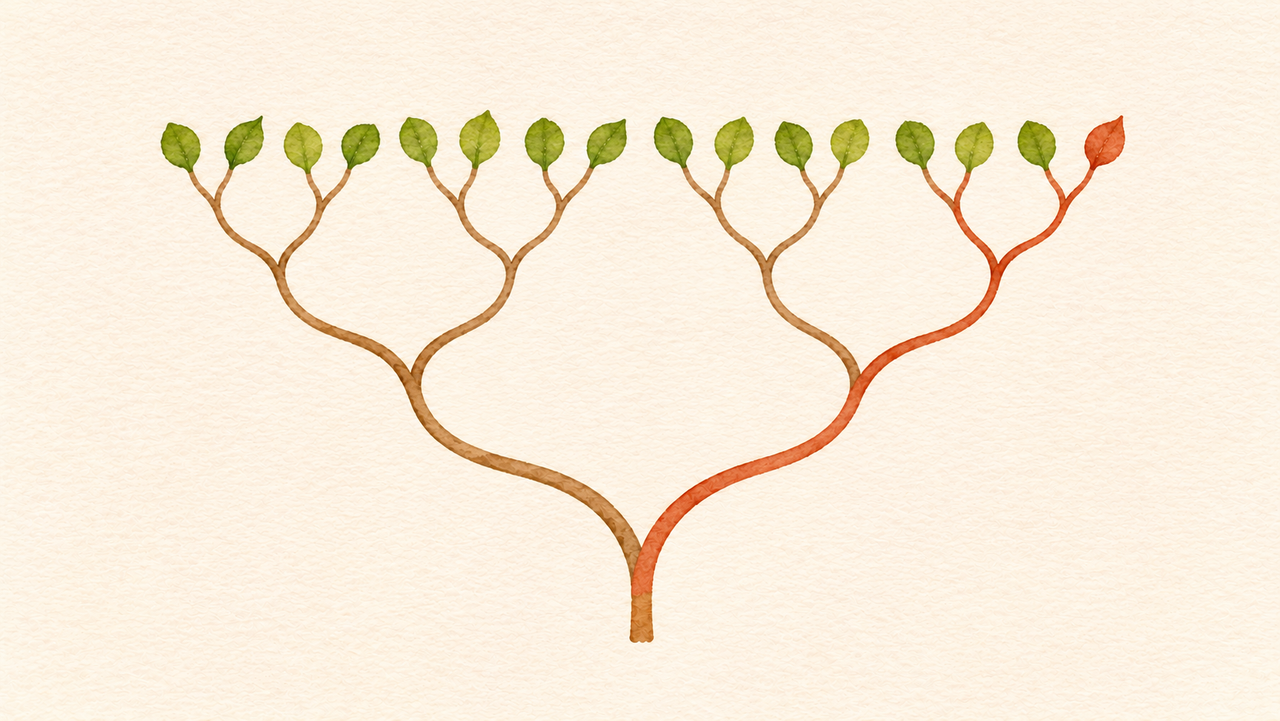
A genus sits inside a family, a family inside an order, and so on up. The levels, with the fiber specialist from our other articles as the example:1
| Level | What it is | Segatella copri |
|---|---|---|
| Phylum | A whole branch of the bacterial tree | Bacteroidota |
| Class | A division of a phylum | Bacteroidia |
| Order | A division of a class | Bacteroidales |
| Family | A set of related genera | Prevotellaceae |
| Genus | A group of closely related species | Segatella |
| Species | One kind of bacterium | Segatella copri |
| Clade (below the species; not an official rank) | A genetically distinct group within one species, found by sequencing | Clades A, B, C and D of S. copri |
| Strain (below the clade; not an official rank) | One lineage of a species, the level a lab isolates and grows, and the level a probiotic product names | An individual S. copri isolate |
Most of the time only genus and species matter for reading an article, with clade and strain coming up when a study looks inside one species. The upper levels come up when a study compares whole branches, which is where names like Bacteroidota and Bacillota (the older names were Bacteroidetes and Firmicutes) appear.
When a name changes
Names change when sequencing shows a bacterium does not belong where it was first put. The fiber specialist was named Prevotella copri in 2007. In 2022 a study of the genus Prevotella found that several of its species belonged in groups of their own and proposed new genera for them, which is where Segatella comes from.2 The organism did not change. Its address did.
A proposal like this is not adopted all at once. The new name is formally valid, and newer papers increasingly use it, but the official list of bacterial names still records Prevotella as the accepted genus, and some recent papers keep the old name: the 2025 study of Indian families in Canada says Prevotella copri, the 2026 study of tribal communities in India says Segatella copri.1 Both mean the same bacterium. On this site we give both names the first time one appears, then use the newer one.
Below the species: subtypes and strains
A species is not one uniform thing. Within Segatella copri, sequencing of more than a thousand genomes found four distinct groups, called clades, each at least a tenth different from the others in its genes.3 These are the "subtypes" our migration article refers to. All four are common in people living traditional lives and less common in westernized populations.
Below the clades are strains: single lineages that a lab can isolate and grow. Strains of the same species can carry different genes for different foods. In the tribal communities of India, the Bifidobacterium strains found in people eating dairy and barley every day were genetically distinct from strains of the same species in industrialized countries, and carried genes for enzymes suited to dairy and grain.4 Two people can both have Bifidobacterium and carry versions of it equipped for different plates.
How we write them here
- The first time a bacterium is named, both the current and the older name, if there is one.
- After that, the plain-English role where there is one ("the fiber specialist") and the Latin name only where it is needed.
- One word in italics is a group; two words are one kind.
PS: This guide is for education. It does not replace personal medical or nutrition advice. Every body is different, and so is every kitchen.
References
Each source is labeled by the kind of evidence it is.
The names
- 1
Parte AC, Sardà Carbasse J, Meier-Kolthoff JP, Reimer LC, Göker M. List of Prokaryotic names with Standing in Nomenclature (LPSN). Leibniz Institute DSMZ. Entry: Segatella copri (Hayashi et al. 2007) Hitch et al. 2023.
LPSN record for Segatella copri; the DOI is the record’s permanent link
- 2
Hitch TCA, Bisdorf K, Afrizal A, Riedel T, Overmann J, Strowig T, Clavel T. A taxonomic note on the genus Prevotella: description of four novel genera and emended description of the genera Hallella and Xylanibacter. Syst Appl Microbiol. 2022;45(6):126354.
The 2022 proposal that created Segatella
Subtypes and strains
- 3
Tett A, Huang KD, Asnicar F, et al. The Prevotella copri complex comprises four distinct clades underrepresented in westernized populations. Cell Host Microbe. 2019;26(5):666–679.e7.
The four clades
- 4
Ebel ER, Kulkarni AS, Mongad DS, Olm MR, Devi SI, Mir BA, et al. Gut microbiomes of tribal communities in India vary with dairy and grain consumption. Gut Microbes. 2026;18(1):2694242.
Bifidobacterium strains carrying genes for dairy and grain