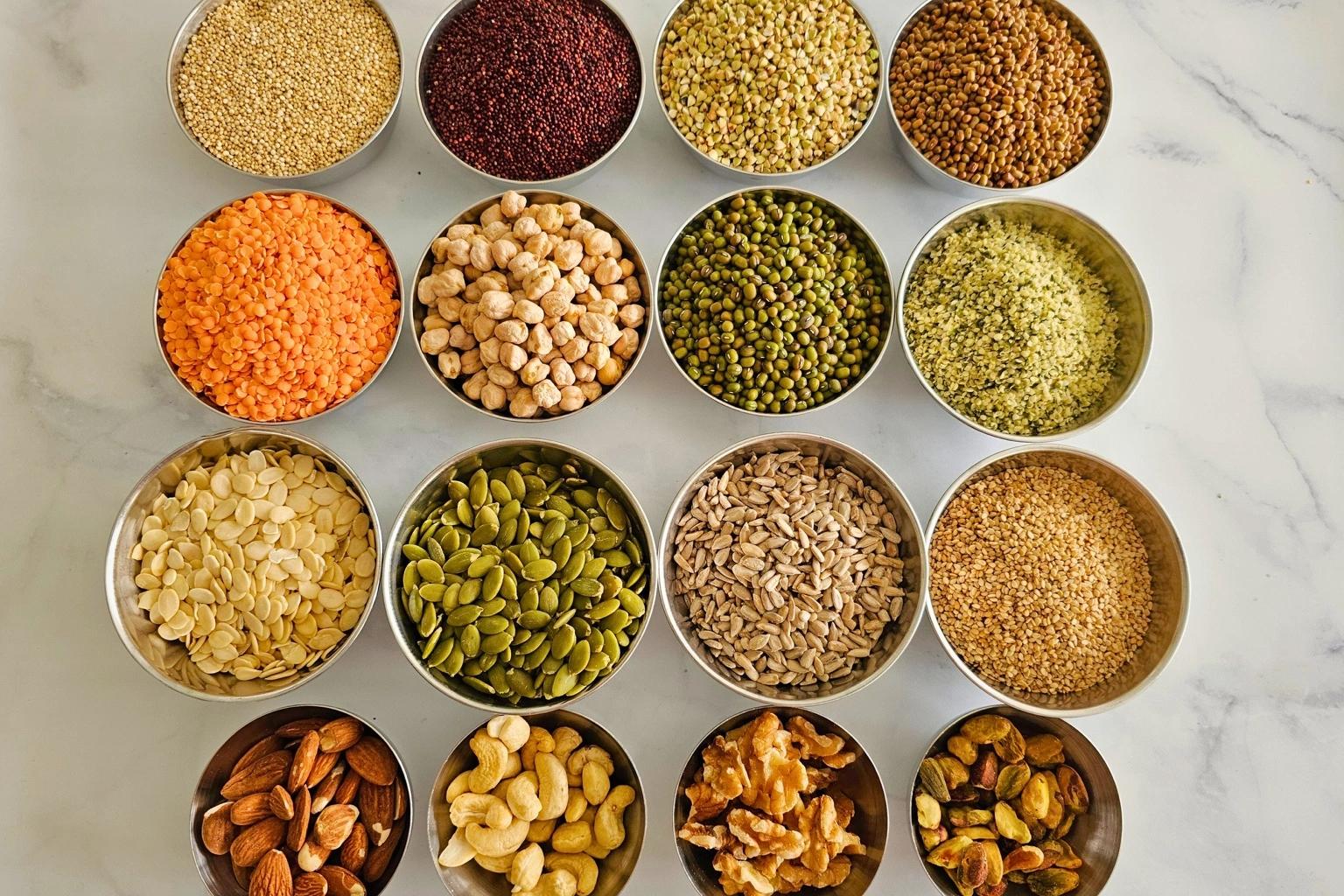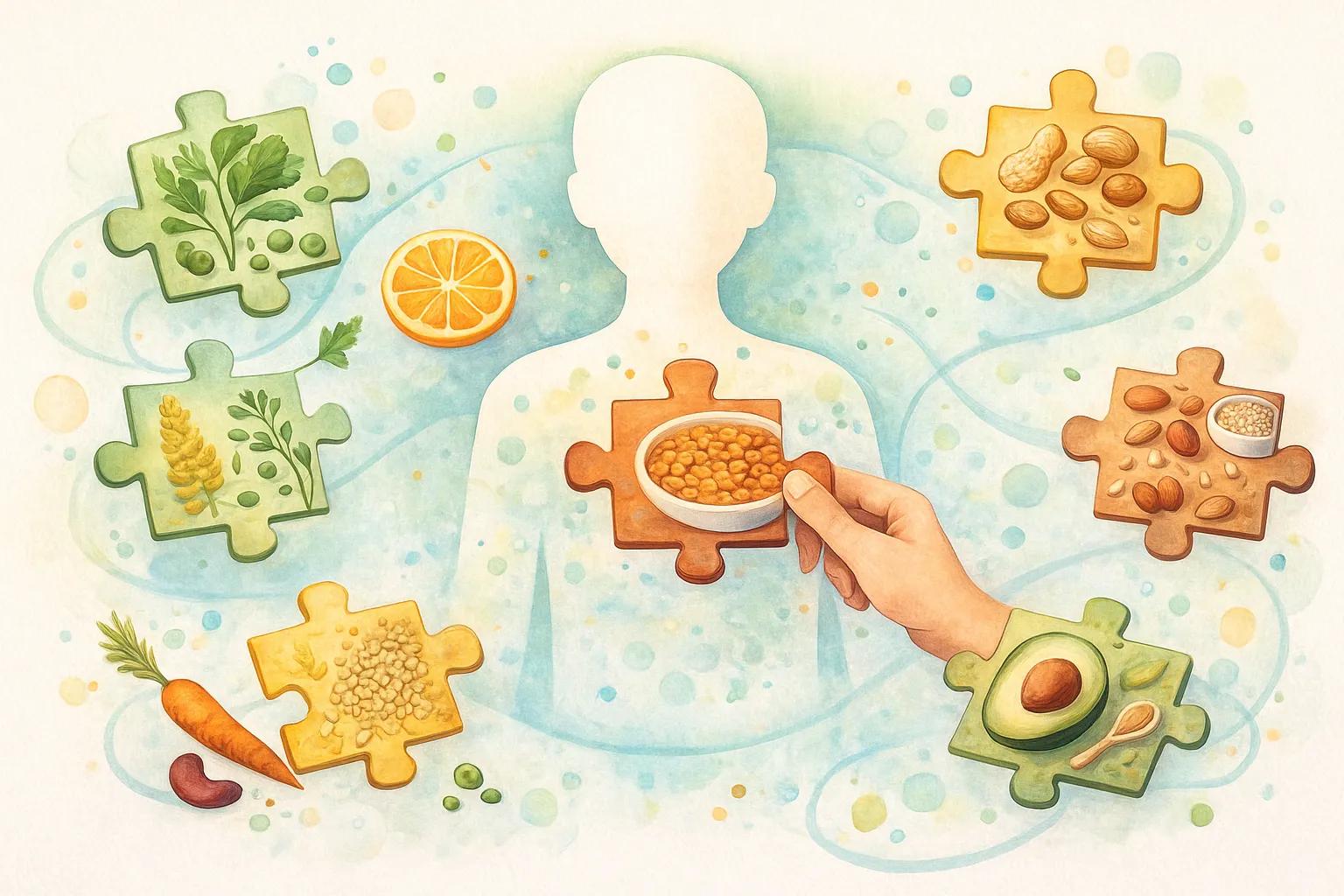
If you read the Nourish Note that accompanies this article, you already know where this began — with a quiet, familiar worry many vegetarian caregivers share. This guide is the deeper layer: the physiology, the clarity, and the reassuring science behind why plant-forward meals support protein far more effectively than we’re led to believe.
It’s an invitation to understand protein the way the body sees it — not the way internet charts or “high protein” marketing frames it.
Protein Begins as Amino Acids — Not as “Sources”
When you eat a bowl of dal, a dosa made from fermented batter, or a handful of roasted peanuts, your body doesn’t label these foods the way we do — “this is protein,” “this is carbs,” “this is fat.” Inside the body, everything is broken down into its smallest workable units. For protein, that unit is the amino acid.
Once released from food through digestion, these amino acids enter a shared, circulating reservoir known as the amino acid pool — a quiet but powerful internal pantry your body draws from over the next 24–48 hours.
Think of it as a slow, steady savings account your body deposits into all day, rather than a one-meal transaction.
From this pool, your body continuously:
- repairs muscle and everyday tissue wear-and-tear
- builds hormones and enzymes
- supports immune cells
- produces neurotransmitters
- fuels growth and development in children
- maintains thousands of microscopic processes you never feel directly
Protein metabolism is not a meal-by-meal system. It’s a continuous cycle, and the amino acid pool is what makes that possible.
That’s the first truth most people never learn.
Essential, Non-Essential & Conditionally Essential — The Simple, Useful Distinction
Amino acids are often grouped into three categories, and understanding them at a high level helps make the rest of protein physiology clearer — without needing to memorize charts.
Essential amino acids
These are the amino acids the body cannot make on its own. They must come from food, whether from lentils, grains, beans, nuts, seeds, vegetables, or dairy (if included).
Non-essential amino acids
These are amino acids the body can generally produce by itself as long as overall nutrition and health are adequate.
Conditionally essential amino acids
These are amino acids the body can make, but not always in sufficient amounts during certain periods — such as illness, rapid growth, pregnancy, postpartum recovery, trauma, or gut healing.
Examples include glutamine (gut lining), arginine (immune function), tyrosine (stress hormones), and glycine (connective tissue and detoxification).
That’s really all most people need to know.
The key takeaway isn’t to track each category, but simply to understand that the body draws from a shared amino acid pool — and that everyday meals contribute to it in different ways.
The Limiting Amino Acid — What It Actually Means
Plant proteins are often misunderstood as “incomplete,” but the truth is simpler: Almost all commonly eaten plant foods contain all essential amino acids — just in different proportions. Some are just present in lower proportions — the “limiting amino acid.”
For example:
- dals → lower in methionine
- grains → lower in lysine
- nuts/seeds → lower in lysine
Lower does not mean missing. Even small amounts accumulate within the amino acid pool, which smooths out these proportional differences across the day.
Where do limiting amino acids actually matter?
They matter in situations where the entire diet is made of the same food over and over again — the same dal every day, the same grain, very few beans, very few nuts, very few seeds. This narrow pattern is what creates limiting amino acid issues, not vegetarianism itself. It’s also why limiting amino acids becomes a concern in clinical malnutrition.
For ordinary vegetarian families, the body solves the “limiting amino acid” question effortlessly, as long as meals shift and vary. A ladle of dal, a handful of peanuts, a spoon of sesame chutney, a bowl of curd (if included), some vegetables, some grains — these small pieces build a complete amino acid pattern across the day. Deficiency rarely comes from plant foods themselves — it almost always comes from repetition and lack of diversity.
The Myth of “Complete Protein at Every Meal” — What Actually Requires It
The idea that every meal must contain all essential amino acids is one of the most persistent nutrition myths — and one of the most irrelevant to ordinary life. Because amino acids circulate for 24 to 48 hours, the body doesn’t evaluate meals individually. Lunch finishes what breakfast began. Dinner complements lunch. Even a handful of nuts in the afternoon becomes part of the same shared pool.
There are only a few contexts where complete amino acid mixtures must be provided at once:
- IV nutrition
- severe trauma or burn care
- certain metabolic disorders
- premature infants
- protein-energy malnutrition (kwashiorkor, SAM)
These situations involve engineered nutrition, not home eating. Outside of clinical care, the body is designed to take its time and to weave amino acids from multiple meals into one continuous supply. For ordinary life, the body thrives on gradual, cumulative intake.
What this really means is that the body needs all amino acids together only in rare medical scenarios where digestion, absorption, or the amino acid pool cannot be relied on. At home, you don’t have to stress about making every plate a “complete protein.” If a meal happens to be complete, wonderful — but even if it isn’t, the meals before and after it complete the picture for you.
How Much Protein Do We Need — And Why Variety Matters More Than Quantity
Most people are surprised by how reasonable protein needs are:
- Adults: 0.8–1.0 g/kg
- Children: ~13–30 g/day (age-dependent)
- Teens: slightly higher for growth
- Pregnancy/Breastfeeding: modest increase
- Older adults: higher for muscle preservation
These numbers come straight from WHO/UNU and ICMR. Vegetarian diets meet these requirements easily when meals vary. Here’s why variation matters:
- Dal contributes a certain amino acid profile
- Nuts & seeds add lysine, methionine, and arginine - These become especially important when soy or dairy aren’t part of the diet.
- Millets & whole grains add different profiles
- Beans add density and depth
- Vegetables contribute small but meaningful amounts
- Fermented foods improve availability
When one category is missing, the amino acid pool becomes less balanced. That’s when vegetarians can fall short — not from lack of protein, but lack of diversity. Deficiency is rooted in monotony, not vegetarianism.
Protein Quality (PDCAAS & DIAAS) — What These Scores Actually Measure (and What They Don’t)
When conversations about plant protein come up, “protein quality scores” like PDCAAS and DIAAS are often used as proof that vegetarian diets are somehow inferior. But these scores do not mean what most people think they mean.
Let’s break it down calmly and correctly.
Protein quality scores were designed to measure two things only:
- the amino acid pattern of a food
- how easily and quickly those amino acids are digested and absorbed
That’s it. They do not assess the overall nutritional value of a food or diet. They don’t account for fiber, micronutrients, polyphenols, gut health, or how foods behave together in a real meal.
PDCAAS/DIAAS Are Useful Tools — Just Not for Evaluating Entire Diets
So why do plant proteins sometimes score lower?
Because of perfectly normal — even beneficial — characteristics of plant foods:
1. They contain fiber. Fiber slows digestion on purpose. PDCAAS/DIAAS “penalize” slow digestion, but the body benefits from it.
2. Plants store protein inside natural cell walls. These walls need to be softened through soaking, sprouting, fermenting, or cooking. Traditional Indian kitchens already do this.
3. Amino acids are released gradually, not all at once. Slow and steady release supports satiety, stable blood sugar, and a calm metabolic response — all desirable outcomes, just not rewarded by the scoring system.
So the very reasons plants appear “lower quality” on paper are actually strengths when you zoom out and look at total health, digestion, and gut ecology.
Why These Scores Don’t Translate to Real Meals
Plant proteins don’t work alone. They work in combinations, across time, within mixed meals, inside diverse diets, and alongside fibers and polyphenols that support gut health, immunity, and metabolic balance.
Protein quality scores don’t measure:
- microbial fermentation
- gut-lining nourishment
- anti-inflammatory benefits
- broader nutrient density
- synergy between foods in real meals
- The amino acid pool collects over 24–48 hours
So when these scores are used to judge an entire vegetarian or plant-forward diet, the interpretation becomes misleading — because a whole dietary pattern cannot be reduced to the behavior of a single ingredient. These tools aren’t wrong; they were designed for isolated ingredients, not mixed meals, so stretching them to evaluate full diets naturally leads to conclusions that don’t reflect how real meals work.
Traditional kitchens already optimized digestibility
Our cooking methods dramatically improve plant-protein availability:
- soaking reduces anti-nutrients and softens fibers
- sprouting increases lysine and enhances digestibility
- fermenting boosts amino acid availability and reduces FODMAPs
- grinding breaks down cell walls
- pressure-cooking softens fibers thoroughly
- tempering with spices supports enzyme release and digestive comfort
These aren’t modern hacks. They are inherited nutritional technologies.
And the most important clarification (straight from FAO/WHO)
According to the FAO/WHO Expert Consultation[^1], PDCAAS and DIAAS were developed to evaluate isolated protein ingredients, single food items, and clinical formulas, rather than whole diets or mixed meals.
This means:
- You cannot “score” a thali with the same rubric as whey isolate.
- You cannot judge a cuisine using the same system as hospital formulas.
- You cannot fully evaluate plant protein adequacy using tools designed for ingredients rather than whole patterns of eating.
It’s a fundamental category error — but it’s made all the time.PDCAAS and DIAAS remain valuable tools — but only when applied within their intended scope.
So what should we rely on instead?
A realistic, body-based approach to protein adequacy:
- total protein intake across the day
- diversity of plant foods
- traditional preparation methods
- steady rotation of lentils, beans, grains, nuts, seeds, and vegetables
- a well-supported amino acid pool
Protein adequacy is a pattern, not a score. It comes from the whole plate, not an isolated ingredient. And when we look through this wider lens, a plant-forward Indian diet — varied and well prepared — is not “low-quality protein.” It is slow, steady, complete nourishment, exactly the way the body prefers.
The Indian Plate: Protein By Accumulation, Not Perfection
If you look at a South Indian or North Indian plate, the brilliance is invisible at first. Nothing shouts “high protein.” There’s no giant slab of anything. Instead, protein comes from many places — a spoon of sambar, a small portion of rasam, a handful of peanuts in the chutney, a few lentils in the tempering, a bowl of curd if included, a dosa made from fermented batter, a millet roti, some rajma, some vegetables cooked with legumes.
Individually, these look small. But the body doesn’t evaluate them individually. It sees the full day — the full 48 hours — and gathers amino acids from all of it. When meals shift naturally across the week, a vegetarian diet becomes extremely reliable.
When meals repeat without rotation, even the best diet narrows. The strength of Indian food has never been in “high protein items.” Its strength is in accumulation and diversity.
Gas, Bloating & FODMAPs — A Gentle Re-Assurance
Many people assume lentils or beans “don’t digest well” for them, but it’s rarely the protein. It’s the prebiotic fibers and plant sugars — the oligosaccharides and resistant starches — that ferment in the colon and create gas. These are part of the FODMAP family, and they feed beneficial bacteria, create short-chain fatty acids, strengthen the gut lining, and support immunity.
Some gas is simply a by-product of fiber fermentation — a routine microbial process. But healthy digestion isn’t gassy digestion; when gas becomes frequent or uncomfortable, it usually means the gut needs time or support to adjust.
Excess gas usually means:
- the microbiome needs time to adapt
- fiber increased too quickly
- same dal is eaten daily
- digestion is under strain (stress, fatigue)
Traditional methods naturally reduce discomfort:
- soaking
- thorough cooking
- using cumin, ginger, hing, garlic
- rotating moong ↔ masoor ↔ toor ↔ chana ↔ rajma
- adding fermented foods
People with IBS have very individual responses to lentils — some tolerate them well, others need a slower introduction. Thorough cooking, soaking, and appropriate portion sizes often make a meaningful difference. And since low-FODMAP diets are designed as short-term therapeutic interventions, reintroduction is always part of the process, ideally guided by a clinician.
Kids & Protein — Steady, Not High
Children don’t need large amounts of protein; they need steady protein spread across familiar foods. A meal with a lentil, a grain, and a nut or seed — idlis with sambar and peanut chutney, or dal with rice and vegetables — contains more than enough for their needs. Vegetarian children do exceptionally well when meals rotate, because growth is supported not just by protein but by the minerals, fibers, and plant compounds that arrive with protein-rich foods.
And most importantly — consistency.
Soy — Optional, Not Essential
Soy is one of the most studied plant proteins and, in traditional food forms like tofu and tempeh, appears safe for most people[^2]. But it does not need to be a central part of a vegetarian diet. Indian kitchens already have dozens of protein-rich foods. Soy is simply one more option — not a requirement.
Families who prefer to avoid soy can still meet all protein needs through dals, beans, nuts, seeds, grains, millets, and dairy (if included).
Protein Powders — When They’re Useful, and What They Can’t Replace
Protein powders can be helpful in specific situations — high physical demand, athletic training, adolescence, pregnancy, postpartum recovery, illness recovery, low appetite, or simply for convenience during exceptionally busy weeks. In these contexts, a clean, minimally processed powder can offer concentrated protein support.
However, powders deliver protein in isolation.
What they leave behind are the components that make plant foods metabolically, hormonally, and microbiologically supportive:
- fiber, which regulates digestion and feeds beneficial microbes
- polyphenols, which modulate inflammation and oxidative stress
- micronutrients packaged within whole foods
- co-factors that support enzyme activity and metabolic pathways
Even the best formulations deliver protein in a way that is different from whole foods. Some powders add fiber, vitamins, or “greens blends,” but they still lack the full synergy of intact plant foods — the combination of fermentable fibers, diverse polyphenols, naturally bound micronutrients, and metabolic co-factors that whole foods carry by design. A supplement can complement this matrix, but it cannot fully recreate it.
For everyday vegetarian families, protein adequacy comes from diversity, rotation, and the nutrient-dense matrix of whole foods — something no powder, however clean, can fully replace. Powders can support a diet when needed, but they were never meant to substitute the quiet intelligence of everyday food.
Closing: The Quiet Intelligence of a Varied Vegetarian Plate
Protein is not a fragile nutrient, and vegetarian diets are not inherently deficient. Dal is not “too little,” nor are plant-based meals lacking by default. What truly determines protein adequacy is the quiet intelligence of everyday eating — the way different foods appear across the day, how rotation naturally balances amino acids, and how the body draws from a 24–48 hour amino acid pool rather than a single plate. When Indian kitchens layer lentils, grains, nuts, seeds, vegetables, and fermented foods in their natural rhythm, they do far more for protein than we give them credit for. Traditional preparation methods like soaking, sprouting, fermenting, and tempering enhance digestibility. Your meals are already doing more than you think; this guide simply explains why they work so well.
PS: This guide is for education, not a substitute for personalized medical or nutrition advice. Please work with your healthcare practitioner for individual recommendations.
Share this article